Engineering in India for Gulf Students (UAE/Kuwait): Fees in AED, Admission 2026
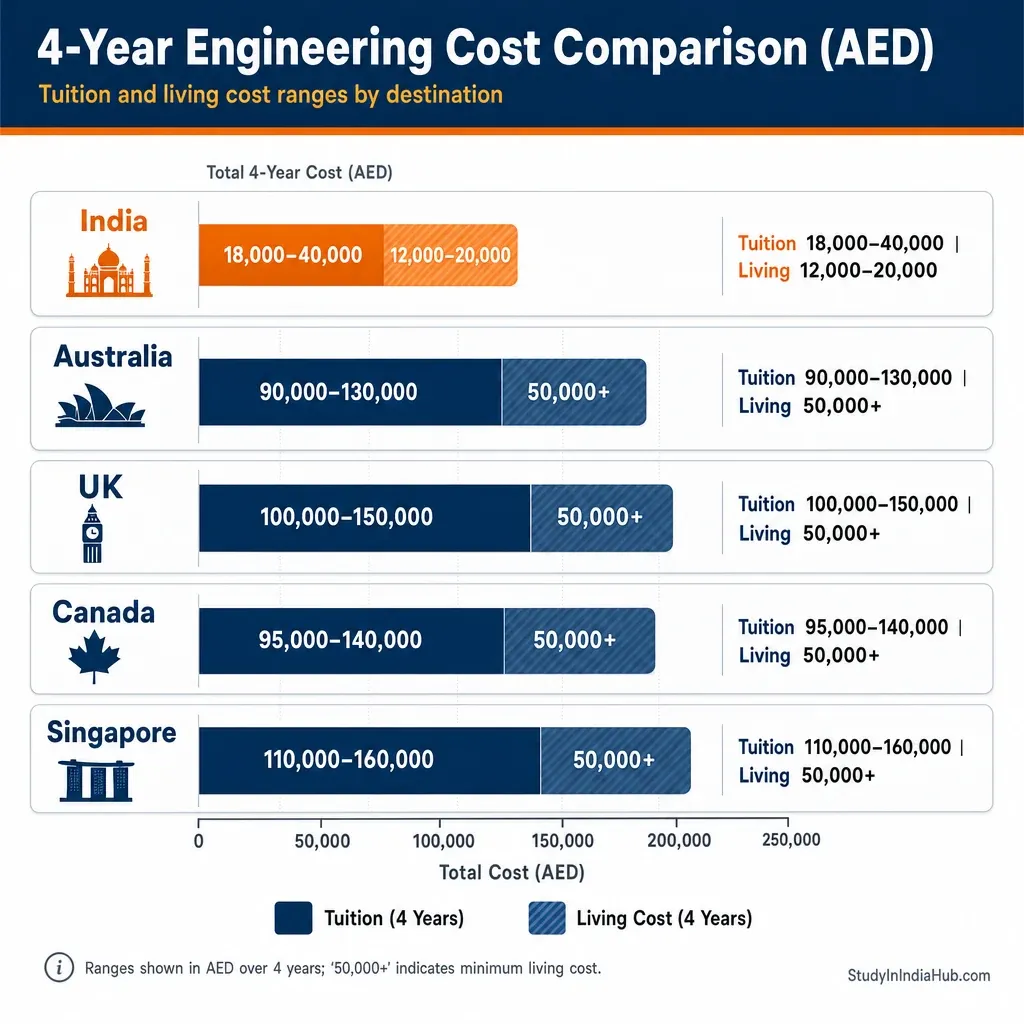
A B.Tech in India costs Gulf students AED 120,000–240,000 all-in. The UK or Australia runs AED 600,000–750,000. That gap is real, but the admission route, equivalency paperwork, and city choice decide whether it actually works out.


Planning to study engineering in India? A four-year engineering degree in India costs a Gulf family roughly AED 120,000–240,000. The same degree in the UK or Australia runs AED 600,000–750,000. That gap of half a million dirhams is why India keeps coming up in conversations across Dubai and Kuwait City.
The cost difference is real, but it's only part of the picture. The admission route, the city, the institution tier, and the order in which paperwork gets done all shape whether the degree actually delivers what the brochure promises.
This guide covers the full picture, from fees in AED and KWD, the three admission routes Gulf students use and the scholarships worth stacking. Let's get into it.
What Engineering in India Actually Costs: The Full Picture
There are more additional costs that often goes missing when planning for it in advance. Let me break it into its actual parts.
Tuition by Institution Type
India is by far a great and affordable destination for engineering students from the UAE. But the total cost also depends on the type of city you are in. India's engineering colleges fall into a few distinct tiers, and fees vary dramatically between them.
| University Tier | Annual Tuition (INR) | AED | KWD |
|---|---|---|---|
| Central University (DASA) | ₹2–5 lakh | 4,400–11,000 | 1,680–4,200 |
| Private Deemed | ₹3–15 lakh | 6,600–33,000 | 2,520–12,600 |
| Govt. Engineering College | ₹50,000–₹2,00,000 | 1,100–4,400 | 420–1,680 |
| Private Engineering College | ₹80,000–₹3,00,000 | 1,760–6,600 | 672–2,520 |
The total four-year engineering cost at NITs and IITs runs ₹6–14 lakh in tuition — a fraction of what equivalent programmes cost abroad. That said, what actually matters is how it compares when you add everything else in.
Hostel, Mess, and Living Costs
On-campus hostel and mess fees for 2026–27 typically run ₹40,000–2,50,000 per year. At BITS Pilani, it's ₹36,000 per semester (₹72,000/year). Chanakya University charges roughly ₹1,84,000/year; roughly AED 880–5,500 per year just for accommodation.
| City | Budget/month | Moderate/month | Comfortable/month |
|---|---|---|---|
| Bengaluru | ₹15,000 | ₹25,000 | ₹42,000 |
| Mumbai | ₹15,000 | ₹25,000 | ₹40,000 |
| Pune | ₹12,000 | ₹20,000 | ₹32,000 |
| Delhi | ₹14,000 | ₹23,000 | ₹38,000 |
Sources: Bengaluru, Mumbai, Pune, Delhi
Amidst this, Mumbai and Pune are consistently the most affordable. Bengaluru's tech-hub areas push rental costs higher than the headline figures suggest. A ₹10,000/month difference in a city choice compounds to ₹1,20,000 over the year.
At a moderate level, "moderate" breaks down roughly as: hostel or PG accommodation ₹6,000–10,000, canteen or self-cooking ₹3,000–5,000, local transport ₹1,000–1,500, mobile plan ₹299/month, and books plus miscellaneous ₹2,000–3,000. In AED terms, that's roughly AED 800–900/month in Pune and AED 900–1,100/month in the other major cities. Build your annual budget as monthly moderate cost × 12, then add a 15–20% buffer for travel and medical expenses.
With the cost picture clear, the next question is how Gulf students actually get into these programmes.
Three Admission Routes: DASA, NRI Quota, and Direct
The admission landscape for Gulf students has a lot of moving parts, but it simplifies into three paths. Which one fits you better depends on the type of institution you're targeting and what your documents look like.
DASA: The Route to NITs, IIITs, and Central Institutes
DASA (Direct Admission of Students Abroad) is the primary route to government-funded engineering institutions such as NITs, IIITs, and Centrally Funded Technical Institutions. The key advantage here is that you're not competing in the main JEE pool of 1.2 million domestic candidates. You submit a SAT or JEE Main score obtained from outside India, along with your school equivalency records and passport.
DASA fees are higher than what Indian students pay at the same institutions, but they're significantly lower than private college rates. They typically run ₹1–3 lakh/year. The tricky part is timing: DASA runs its own cycle, independent of the main JEE counselling calendar. As of the 2026 intake, the DASA PG cycle has been confirmed but hasn't released a full schedule, so monitor the official DASA portal directly for dates.
NRI/Foreign Quota: Private and Deemed Universities
This is the path most Gulf students end up taking. Private and deemed universities can admit foreign nationals and NRIs in an additional 15% above their standard intake. The fee range is broad:
- Christ Deemed University, Bengaluru: ₹2–6 lakh/year for NRI quota
- Ashoka University, Sonipat: ₹10–12 lakh/year
- Nirma University (BBA-MBA route): approximately USD 6,650/year
Two colleges can both call them "NRI seats" and charge very different amounts.
If you or your family are from a SAARC country like Bangladesh, Nepal, Sri Lanka, but resident in the Gulf, check whether your target university offers SAARC quota rates. Some central universities do; Jamia Millia Islamia, for instance, offers a USD 500 discount on the admission fee for SAARC-nation applicants, and the Central University of Himachal Pradesh has SAARC categories starting at ₹2,000 in certain streams.
The Step-by-Step Application Process
With your admission route chosen, here's the step-by-step process of you can apply:
Step 1: Set up your portal accounts early
ICCR A2A applications for 2026–27 ran from 27 February to 22 April 2026. Most university portals open in January–February. Create accounts before the peak season because last-minute registrations are where people lose time they can't recover.
Step 2: Sort your entrance exam
For DASA-route applications to NITs and IIITs, you'll need SAT or JEE Main scores. Many private universities either have their own entrance test or waive it entirely for international applicants. HSC board results feed into JEE Main scoring, so they matter beyond just document verification.
Step 3: Get your documents attested properly
Certificates need attestation by your school principal or the Ministry of Education in the UAE or Kuwait. A notary public stamp alone is not sufficient, and a transcript without proper attestation gets rejected at the first document review. IELTS on Computer results come back within 1–5 days, so the English proficiency piece is relatively easy to sort.
Full document checklist:
- Passport (valid 6+ months beyond intended stay)
- Attested transcripts and marksheets for all years
- School leaving certificate (original or attested copy)
- AIU equivalency certificate
- English proficiency (IELTS/TOEFL, or medium-of-instruction letter)
- Bank statements covering tuition and living costs
Step 4: Submit and wait
Most universities have a March–April 2026 deadline for July enrolment. Results typically come out in April–May. For the DASA path specifically, there's a separate results calendar, so don't assume it aligns with the private college cycle.
Step 5: Visa and FRRO
The S-1 student visa is documentation-only. Processing takes 5–7 business days from the UAE and 7–10 business days from Kuwait. Once you land, FRRO registration is mandatory within 14 days of arrival for any visa valid over 180 days.
Scholarships Worth Knowing About
ICCR A2A Scholarship is the most substantial option for students from the UAE, Kuwait and the Middle East. It covers tuition at central and state universities associated with ICCR. But the competition is intense; around 4,000 applications competed for approximately 200 fully funded slots in 2026–27. That's roughly a 5% acceptance rate, which means applying without expecting it but applying regardless, because the upside is too large to pass on.
Beyond ICCR, a few other schemes are worth stacking:
| Funding route | What it is | Key detail |
|---|---|---|
| Atal Bihari Vajpayee General Scholarship | Broader ICCR stream, not country-specific | 640 slots; offer letters by June 15, 2025 |
| Sushma Swaraj Silver Jubilee Scheme | ICCR stream | 100 slots in 2022–23 |
| SAARC Quota / Fee Concession | University-level fee cut, not a full scholarship | Many central universities cut 10–25% of tuition; confirm with admissions |
| CIHM tuition waiver | Hospitality institutes in Delhi, Mumbai | Up to 40% tuition waiver |
Most Indian universities accept combining a government scholarship like ICCR with an institutional merit award, but you can't stack two government schemes. So always read the terms on your offer letter before assuming awards are combinable and align any scholarship amount with the specific tuition figure in your offer letter.
Placements and What Happens After
For students from the Middle East and Gulf regions, the career logic of an Indian engineering degree usually works like this: study in India, get exposure to one of the world's largest tech and industrial job markets, build a profile, then bring it back to Dubai, Abu Dhabi, or Kuwait with a more coherent story for employers.
Placement data from the 2024–25 cycle at the institutions most Gulf students target:
| Institute | Package (INR) | Approx. AED / USD | Top recruiters |
|---|---|---|---|
| BITS Pilani | Median ~19.5 LPA | AED 86,000 / USD 23,400 | Microsoft, Amazon, Goldman Sachs |
| NIT Trichy | Average ~16 LPA | AED 70,000 / USD 19,200 | L&T, Tata, Qualcomm |
These numbers are derived from the official placement reports of each institute. They propose that engineering graduates can recoup their expenses within a few years of employment.
Final Thoughts
An engineering degree in India is, for most Gulf families, genuinely one of the better financial decisions available in international education right now. The cost gap compared to Western destinations is real, the placements at the top-tier institutions are strong, and the proximity to home makes the whole experience more manageable.
Related guides
- Engineering in India for Nepali Students: Colleges, Fees in NPR, and Admission 2026
- MBA in India for Students from the UAE & Middle East: A Practical Guide for 2026
- Engineering in India for International Students: Colleges, Fees & Careers (2026)
- Study in India for Students from UAE & Kuwait: Complete Guide for NRIs 2027
- MBA in India for International Students: Best Colleges, Fees & ROI (2026)