Can International Students Work While Studying in India? (2026)
India's student visa has no off-campus work allowance. This guide covers exactly what's permitted (internships, assistantships), what isn't, the tax and compliance risks, and how to convert to a work visa after graduation.


Many international students that I have spoken to in recent years have had the same question: "Can I pick up some part-time work to cover my expenses?" It's a completely reasonable thing to wonder as students in Australia, Canada, and the UK routinely work while studying, so why not India?
The honest answer is that India works differently, and understanding the rules before you land here can save you a lot of trouble. This guide walks through exactly what's allowed, what isn't, what it costs you in taxes and compliance risk if you get it wrong, and what actually happens after graduation if you want to stay and work.
Can International Students Work in India? The Short Answer
Under the S-1 student visa, off-campus part-time work isn't permitted. What you can do is limited to activities tied directly to your course: university-approved internships, on-campus jobs, and research or teaching assistant roles your institution formally recognizes.
| Country | On-Campus Work | Off-Campus Work | Hours During Term |
|---|---|---|---|
| India | Generally not permitted | Not permitted | None (study-only visa) |
| Australia | Permitted | Permitted | Up to 48 hours per fortnight |
| Canada | Permitted | Permitted | Up to 24 hours per week |
| UK | Permitted | Permitted | Up to 20 hours per week |
Don't build any part of your budget around part-time income here the way you might for the UK or Canada because that's not an option. If you want to work, the actual test is simple: if the work isn't tied to your course, your department, or a formally sanctioned campus role, assume it's not allowed. You'll need a university approval letter that matches your visa conditions before doing anything paid.
What the Student Visa Actually Allows
There's one rule underneath everything else here: general employment in India is off the table on a student visa.
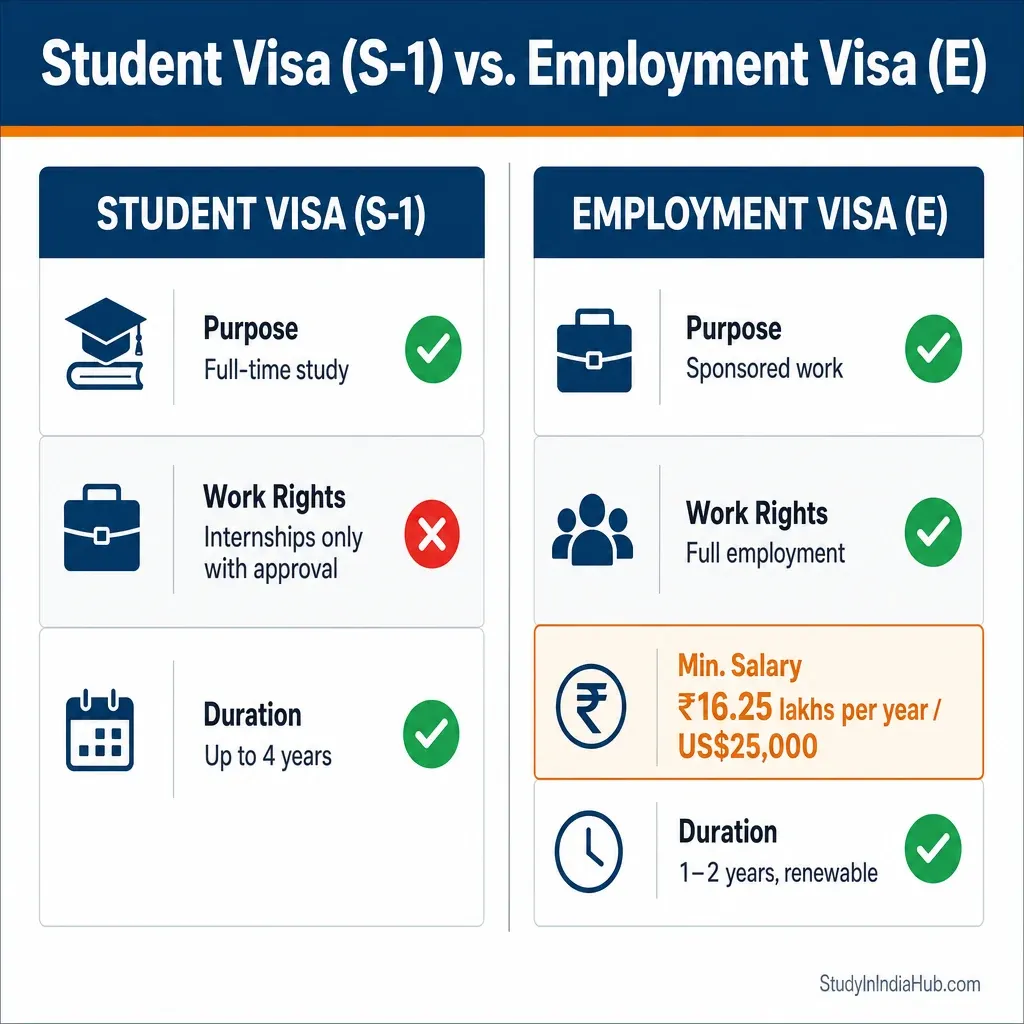
But here's the misunderstanding I run into most often: people assume "student visa" works something like a light version of a work visa. It doesn't. The S-1 is a legally distinct category from an Employment (E) visa, and applying for it tells the Indian government, in effect, that you're here to study, not work. Internships are the one carve-out, and even those need university approval first.
Take a typical part-time or freelance job outside that structure, and you're risking deportation, a flag on the e-FRRO portal, and complications for your university's broader international-student standing. I once worked with a Nepali student whose roommate quietly took on freelance work without telling anyone and a routine FRRO check caught it. I
It pulled in the whole shared household, requiring the university to file clarifications for everyone involved. None of that needed to happen.
Here's how the student visa compares to employment visa:
Work That Is Permitted: Internships, Assistantships and On-Campus Roles
Everything that's actually allowed shares one structure: it has to connect to your university, it has to be documented in writing, and that documentation has to exist before you start your work. Here's what genuinely falls inside that boundary.
Curriculum-Linked Internships
The only internships that count are ones built into your academic program and listed in your course handbook, written into your syllabus, with your department issuing a formal letter confirming it's a required part of your degree. The internship itself has to be with an India-based organization, and your university is the one who liaises with both the employer and your FRRO office on your behalf. A Computer Science BTech student taking a software internship fits this cleanly; a retail job, even part-time, doesn't fit at all.
Here's where it usually goes wrong in practice: a student treats a casual summer placement as harmless "experience," but the institute never formally logged the approval. So don't forget to check first: does your university run a defined process for internship approvals? Most do like SPPU, for instance, runs this through a dedicated International Centre. Confirm with your department head that the internship counts toward your degree, get a formal approval letter from your placement cell or international office, hand that letter to your employer, and keep a copy for your own FRRO records.
Research and Teaching Assistantships
This is the most straightforward route, mainly because your own university handles compliance directly. Teaching assistant roles, research assistant roles, library support are some roles that your department defines, writes a letter confirming it's part of your program, and files it alongside your FRRO documentation. For PhD and research-master's students, this is usually baked into your funding package from the start, not something you go hunting for separately.
These roles typically come with research or teaching duties tied to your program. How you actually get paid depends on your university or scholarship body; ICCR, for example, has run its scholarship disbursements through the government's PFMS system since 2021, which is a legitimate, traceable channel if you're on that kind of funding. Nepali students applying through the A2A portal can access this across undergraduate, postgraduate, and doctoral levels.
Research Roles and Lab Work
In a research-heavy programs like Masters by Research, PhD, certain honors undergraduate tracks; your university may place you directly into a lab or research unit. This counts as academic work, not employment. PhD and Research Masters students get unlimited hours here; a letter from your supervisor confirming the role and hours is what makes it official. Undergraduate and taught postgraduate students doing research assistantships stay within the same 25-hour term cap, with more flexibility during breaks.
What You Cannot Do
Outside the structures above, the line is firm: no café or retail jobs, no independent contracting for outside or overseas companies, no freelance work of any kind. Students who've tried any of these routes have run into visa cancellations or serious FRRO complications.
Permissions and Documentation You Need
Beyond the role-specific paperwork above, there are three broader layers of documentation worth handling before you accept anything including an internship, an assistantship, or a campus role.
Step 1: Get university clearance
Always remember that no role is automatically approved. Your international office or department reviews the job description, the hours, and whether it lines up with your visa terms. At SPPU, this typically takes three to five business days once you've submitted the offer letter and a short role description. At Mumbai University, it runs through your department directly. Either way, you need a written approval letter on official letterhead, and you need to hold onto it for both FRRO registration and as backup if your employer ever asks.
Step 2: Register with FRRO within 14 days
This is non-negotiable and the timeline is short. The process runs entirely online: set up your account, register your application, upload your documents, and submit. Processing usually finishes within 24 hours and no office visit is needed unless you're specifically contacted. You'll need your passport (first and last four pages), visa page, admission letter, and your university approval letter.
For Nepali students specifically: despite the open-border arrangement, FRRO registration is still required for any stay over 180 days, a rule that now applies across all full-time Nepali enrollments.
Step 3: Verify your visa conditions and any NOC requirement
Your S-1 visa carries specific conditions printed on the page itself and some internships are explicitly allowed, others aren't. Some employers will also ask for a separate No Objection Certificate; it's uncommon for internships specifically, but worth asking about early. Your international office can usually turn one around in two to three days.
Taxes, Earnings Limits and Compliance Risks
The moment you start earning money under your student visa, the rules tighten considerably. Here's what genuinely happens once you're earning anything in India on a student visa.
All income earned in India is taxable including a research stipend, an on-campus salary, a teaching honorarium, all of it. You'll file returns with the Income Tax Department using a PAN card, and your tax bracket depends on your residency status and total earnings under the Income Tax Act, 1961. If your situation is at all ambiguous, it's worth checking your residency classification under Section 6 with someone who actually knows Indian tax law.
The most common mistake I have seen is not getting a PAN before your first payment lands, which then triggers higher TDS deductions on stipends and grants than necessary. If you have taxable income, your return is due by July 31 following the relevant financial year (April–March), and you'll want to keep Form 16 or stipend receipts on hand. Students who sort out their PAN early almost never run into refund or filing delays later.
Working in India After You Graduate
Now let's come to the scenario where you have graduated and started working. There's no automatic post-study work visa in India. To stay and work after graduation, you need to convert your Student Visa into an Employment Visa through a sponsoring employer before your student status expires. The biggest roadblock is the minimum salary threshold: your offer needs to clear a gross annual salary above roughly USD 25,000 (₹16.25 lakh), which is the recognized floor for Employment Visa eligibility. If your offer comes in even slightly under that line once converted to rupees, the FRRO will likely turn it down. One student lost a Bangalore offer specifically because the "Cost to Company" figure included non-cash perks that immigration didn't count toward the base salary.
Is there a hard earnings cap?
Not formally. But that's not the same as unlimited. Your university, as your visa sponsor, carries its own compliance obligations, including a roughly 95% enrollment and attendance expectation. If you're visibly working 40 hours a week instead of focusing on your studies, that reflects on your sponsor and puts your visa at risk regardless of whether any specific number was technically exceeded. The real issue here is compliance, not the size of your paycheck.
What happens if you work without permission?
This isn't a fine-and-a-warning situation. Once a violation is logged, it stays visible to whichever visa officer reviews your file next. The only way to avoid complications is to get written university approval before any paid work, and keep it with your visa documents permanently. That letter is your evidence the work was sanctioned.
| Situation | Safe approach | Risk if ignored |
|---|---|---|
| Paid work on the side | Verify university permission and visa conditions first | Visa cancellation |
| Internship for credit | Keep the university approval letter | Deportation |
| Any paid role | Track tax and payment records | Future entry bans |
The table above helps you take a safe approach that will not jeopardize your visa processes.
The Bottom Line
If there's one mental model worth carrying out of this entire guide, it's this: in India, permission always comes before the work, never after. The system here isn't designed to catch you out; it's just unusually literal about sequence. So be vigilant and get university clearance, then the NOC if needed, then FRRO registration, then the work itself. Do it in that order, every time and almost everything in this guide stops being a risk and just becomes a checklist.
Related guides
- What Is Student Life Like in India for International Students? (2026)
- How Much Does It Cost to Study in India for International Students? (2026 Breakdown)
- Is India a Good Place to Study for International Students? (Honest Review 2026)
- Indian Student Visa: Step-by-Step Process for International Students (2027)
- Study Loans for International Students Coming to India (2026 Guide)