What Is Student Life Like in India for International Students? (2026)
India hosts 46,000+ international students yearly. From campus routines to festivals and FRRO paperwork, here's what student life actually looks like on the ground in 2026 for international students in India.

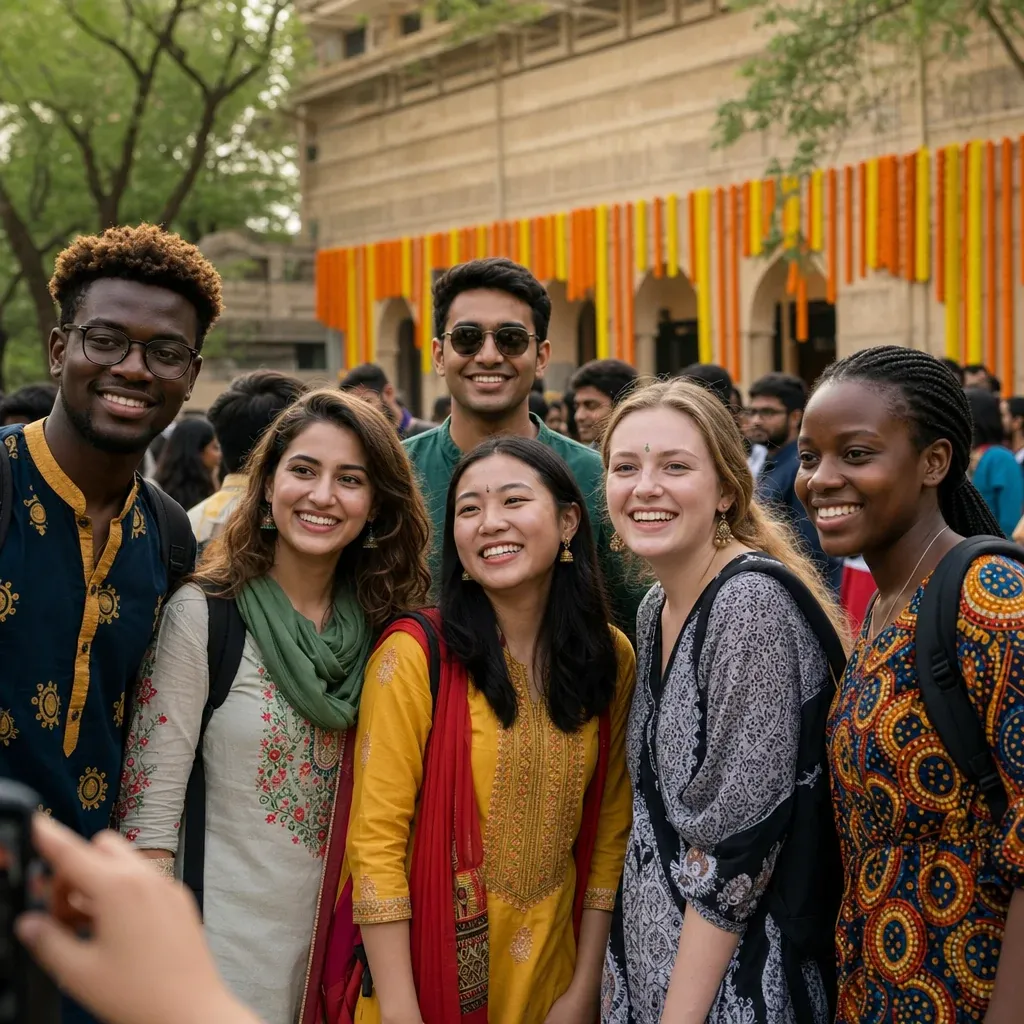
If you ask any international student, what surprised them most about studying in India, you'll rarely hear "the academics." It's the pace of everything else including the noise, the festivals, the food, the paperwork, the friendships that form faster than you expect. India's campus life is genuinely immersive in a way that's hard to prepare for from the outside.
This guide is for students who want an honest picture before they arrive: what a typical day actually looks like, how much things cost city by city, where the community is, and what trips people up in the first month.
The First 14 Days: Get This Right Before Anything Else
Before campus life can begin in any meaningful way, there's a short window of administrative tasks that can't be ignored.
If your student visa is valid for more than 180 days, you must register with the FRRO (Foreigners Regional Registration Office) within 14 days of arrival. Registration is now done online through the e-FRRO portal and no office visit is required unless you're contacted. The process usually takes around 24 hours once submitted correctly. If you miss the deadline, however, you're looking at fines of up to ₹10,000 and potential complications when you need to leave the country.
The rest of the first-week checklist:
- Open an NRO savings account — you'll need your passport, student visa, admission letter, and proof of Indian address. SBI has the widest branch network; HDFC and ICICI have better digital platforms and require a lower minimum balance (₹10,000 vs. ₹1 lakh for SBI in metro areas).
- Note: Part-time work is not permitted on an S-1 student visa. Only internships that are formally approved as part of your curriculum are allowed.
An older student from your programme can often walk you through the banking process in a couple of hours. That's exactly the kind of connection worth making in week one.
A Typical Day on Campus
Once the paperwork is behind you, campus life settles into a rhythm fairly quickly.
Typically the core lectures run from roughly 9:00 AM to 4:00 PM (Study in India) at most public universities, which account for about 73.7% of total enrolment across India's 800+ universities. Attendance is tracked carefully and the standard requirement is 75% attendance to maintain your S-1 visa status. This isn't flexible, and universities enforce it.
After classes, the campus common areas fill up. There's usually a cafeteria or canteen where students hang out and library and lab time stretches into the early evening. Since part-time work isn't an option, this period is genuinely yours for academics, clubs, or getting to know the campus.
Most hostels have a curfew between 9:00 and 10:00 PM, so check yours in the first week rather than finding out the hard way.
Campus culture in Pune: Student city of India
Where you study shapes everything from your daily commute, your social life, your monthly budget, and how quickly you build a routine.
Pune is built around its student population. The academic calendar sets the pace of the whole city, and local businesses, landlords, and auto drivers are accustomed to international residents. It's easier to build a routine here, and the university community is tighter-knit. Neighbourhoods like Viman Nagar, Kothrud, and Hinjewadi are well-connected and feel manageable from day one.
What Things Actually Cost
Now that we have talked about the campus culture, we have to cover the costs. The numbers on university websites rarely reflect what you'll actually spend. Here's a more grounded breakdown.
Accommodation is your biggest line item
When calculating costs, you major stake is on accomodation.
- Delhi: campus hostel ₹5,000–₹12,000/month; private PG ₹8,000–₹18,000
- Mumbai: PG ₹8,000–₹20,000 (often at the upper end near the University of Mumbai)
- Pune: PG ₹6,000–₹15,000
- Hyderabad: shared accommodation with meals and utilities, ₹4,000–₹6,000
Hostels and PGs that bundle utilities and meals into one payment are usually the better starting point. The all-in figure is easier to plan around, and you're not surprised by electricity bills in month two.
Beyond rent, here's what a typical month looks like:
| Expense | Estimated Monthly Cost |
|---|---|
| University mess plan | ₹3,000–₹5,000 |
| Eating out | ₹5,000–₹12,000 (Mumbai); ₹5,000–₹10,000 (Pune) |
| Transport | ₹1,000–₹3,000 |
| Utilities + mobile data | ₹1,500–₹2,500 (shared flat) + ₹300–₹600 |
| Recreation | ₹2,000–₹5,000 |
Annual costs at state universities and public medical colleges range from ₹1,20,000 to ₹2,40,000. Living expenses for the full year typically fall between ₹1,50,000 and ₹3,50,000 depending on city and lifestyle.
One thing to plan for before you arrive: You'll need a buffer for the first month. Security deposits on rentals are typically one to three months' rent, and you can't cover any gaps with part-time income.
Food, Festivals, and Fitting In
Food is one of the fastest ways to feel at home, and in India, it's rarely a problem.
About 39% of Indian adults identify as vegetarian, which means plant-based options are built into the fabric of daily eating, not treated as a special request. Halal restaurants and butcher shops are easy to find in Mumbai and Pune, particularly near major universities. University dining halls typically offer both vegetarian and non-vegetarian options.
If you're vegan, have allergies, or follow a specific diet, speak to your hostel warden and the International Centre during the first week. Mess managers can often accommodate special requirements, but only if you raise it early.
Festivals are where campus life shifts into another gear entirely. They're not background events and they change the campus atmosphere for days.
- Holi (March): Coloured powder, water, sweets. The most inclusive event for international students across the board.
- Diwali (Oct/Nov): Lights, shared meals, rangoli competitions, fireworks. One of the best times to be on campus.
- Ganesh Chaturthi (Aug/Sep): Especially big in Maharashtra: parades, community prayers, a genuine neighbourhood event.
At SPPU, the International Centre organizes festival activities specifically for international students, and participation is open to everyone regardless of background. Students from Nepal, Bangladesh, and Nigeria have all described these as the moments the adjustment clicked.
Eid is observed on campus, and Christmas exists but is quieter than in Western countries. Your own community's celebrations matter too; Nepali students in both Mumbai and Pune organize well-attended Dashain and Tihar events with food, music, and prayers.
Amidst all the festivities, a major question that arises is how would you commute and how much would it cost?
Getting Around: Transport and Daily Logistics
The best and most affordable way to commute is through public transport. Monthly transport costs typically run ₹1,000–₹3,000, depending on how often you use metro, bus, or ride-hailing. That figure sounds modest until you realise it covers not just campus commutes, but also trips to the bank, and grocery stores, all of which happen frequently in the first few weeks.
| Transport Mode | Best For | Typical Cost (Short Trip) |
|---|---|---|
| Metro | Avoiding traffic in Delhi/Mumbai | ₹10–₹60 |
| Auto-Rickshaw | Last-mile connectivity | ₹25–₹100 |
| Ride Apps | Door-to-door safety | ₹100–₹400 |
| Local Bus | Budget daily travel | ₹5–₹40 |
Start with Uber or Ola until you know the local auto-rickshaw rates. Use the apps as a price reference even when you're negotiating a street fare so it stops you getting overcharged on short trips. Always share your live location when travelling at night. In Delhi, the Metro acts as your vital assistance and in Pune and Mumbai, you'll rely on PMPML buses or auto-rickshaws.
In your first week, make it a point to find your nearest metro station, bus stop, and a reliable taxi stand. Ask around in the student community, how do they travel and which route is the best for daily commute.
The International Student Community
You won't be as alone as you might fear. India hosts approximately 46,000–49,000 international students from over 160 countries, according to the AISHE survey. The largest communities come from Nepal (~28%), Afghanistan, and Bangladesh, with significant numbers from the UAE and Sri Lanka.
At SPPU alone, around 14,000 international students from over 102 countries make it the largest international cohort at any Indian university. Mumbai University's international student support runs across colleges and departments.
Where to find your community
If you are new, finding your community and the right people to connect should be your first goal.
- Country-specific Facebook groups: Students in both cities run active groups covering housing advice, food, and celebrations.
- Orientation week: The most efficient way to meet people from your programme and understand the registration process.
- WhatsApp groups by intake year or nationality: Common at most universities; ask around in the first week.
- Campus clubs: Cultural societies, academic groups, and sports teams. Show up twice before deciding it's not for you.
The students who settle in fastest aren't necessarily the most outgoing but they're the ones who plug into a network early rather than waiting until they feel ready.
Challenges to Expect (And How to Get Ahead of Them)
When you move to India as an international student, there are various challenges that you might face:
The biggest initial shock isn't the food or the heat. It's the sensory overload; the noise, the crowds, the pace, all combined with a dense administrative checklist in the same two-week window. Students who arrive knowing this tend to take it in stride. Students who don't often describe their first month as overwhelming.
Document mismatches cause more delays than almost anything else. A name spelled differently across two documents, an address that doesn't match your hostel booking, a visa end date that doesn't line up with your course; any one of these can stall your FRRO registration for weeks.
Missing deadlines is the other pattern that repeats every year. FRRO registration, hostel allocation, scholarship applications, all hav deadlines. Skip one and the others tend to cascade. Build a calendar before you arrive and set reminders two weeks ahead of every deadline.
Budgeting without income catches students off guard too. There's no option to pick up a part-time job to cover a shortfall. Arrive with a buffer, at minimum enough for your first month's rent, a security deposit, and incidentals while your bank account is being set up.
Final Words
Student life in India is genuinely rewarding, but it rewards preparation more than spontaneity. The academic environment is rigorous, the campus culture is warm and active, and the cost of living is among the most manageable of any study destination in the world.
What it asks of you in return is administrative discipline in the first two weeks, a willingness to engage with your campus community before you feel fully comfortable, and a realistic budget that doesn't rely on income you won't be able to earn. Get those three things right, and most students find that India grows on them faster than they expected.
Related guides
- Indian Student Visa: Step-by-Step Process for International Students (2027)
- Universities in India That Provide Visa Support for International Students
- How to Apply to Indian Universities as a Foreign Student (2026)
- Best Universities in India for International Students (2026 Rankings + Fees)
- Study in India for Nepali Students: Complete Guide 2027
- When to Apply to Indian Universities: Intake Calendar 2026-2027