SOP Guide for Indian Universities: How to Write a Winning Statement of Purpose
Indian admissions committees reject 40–50% of SOPs and not for weak grades, but for sounding generic. This guide breaks down exactly what committees look for, how to structure each section, and the specific phrasing that separates a memorable SOP from a forgettable one.


In the last academic year, more than 70,000 international students applied to Indian universities. Do you know what differentiated the students who got selected from those who don't? A strong SOP.
You must have all heard about the statement of purpose (SOP) and how it is important when you are applying to different universities. An SOP can really create a difference when there's a pile of students looking for the same seat at a top tier college. But how do you write a strong SOP that gets you the seat at your desired college and why is it necessary? Let's find out.
What is an SOP and Why Indian Universities Ask for One
Most universities ask for an SOP along with your college application. An SOP is a one-to-two-page document that does three jobs at once: it explains why you want this specific program, what you bring to it, and where you're headed afterward. Think of it as the thing your grades and exam scores can't say on their own. It is for the committee to check whether your background actually lines up with the program, and whether your goals are realistic enough that you'd plausibly finish the degree.
Most postgraduate tracks like MBA, MSc, MTech, ask for one, especially at places like IIT Bombay and the top-tier MBA schools. Plenty of undergraduate programs skip it entirely; engineering colleges often don't bother, while research-focused and liberal arts institutions usually do. I would suggest, check the department's admission portal directly, or email the office before you start writing. We've seen both failure modes play out: students who skipped a required SOP and lost their seat, and students who spent weeks polishing one that was never asked for.
One more framing point worth getting right early: an SOP isn't your life story, and it isn't a CV with sentences stitched between the bullet points. With India hosting over 8,000 courses across more than 600 institutions, and a single international office like SPPU's managing roughly 14,000 international students from over 100 countries, the SOP is the one document that's actually built to separate a genuinely good fit from a mass-applied template.
What Indian Admissions Committees Look For
This is one of the most pressing questions among international students planning to study in India. To answer that, there are four things, mainly: clarity, authenticity, academic fit, and a career rationale that holds up under scrutiny. The SOP isn't decorative, it gets reviewed alongside your transcripts, proof of admission, and application form, as one piece of a single decision package. And expectations shift a bit depending on where you're applying from within the wider South Asian region.
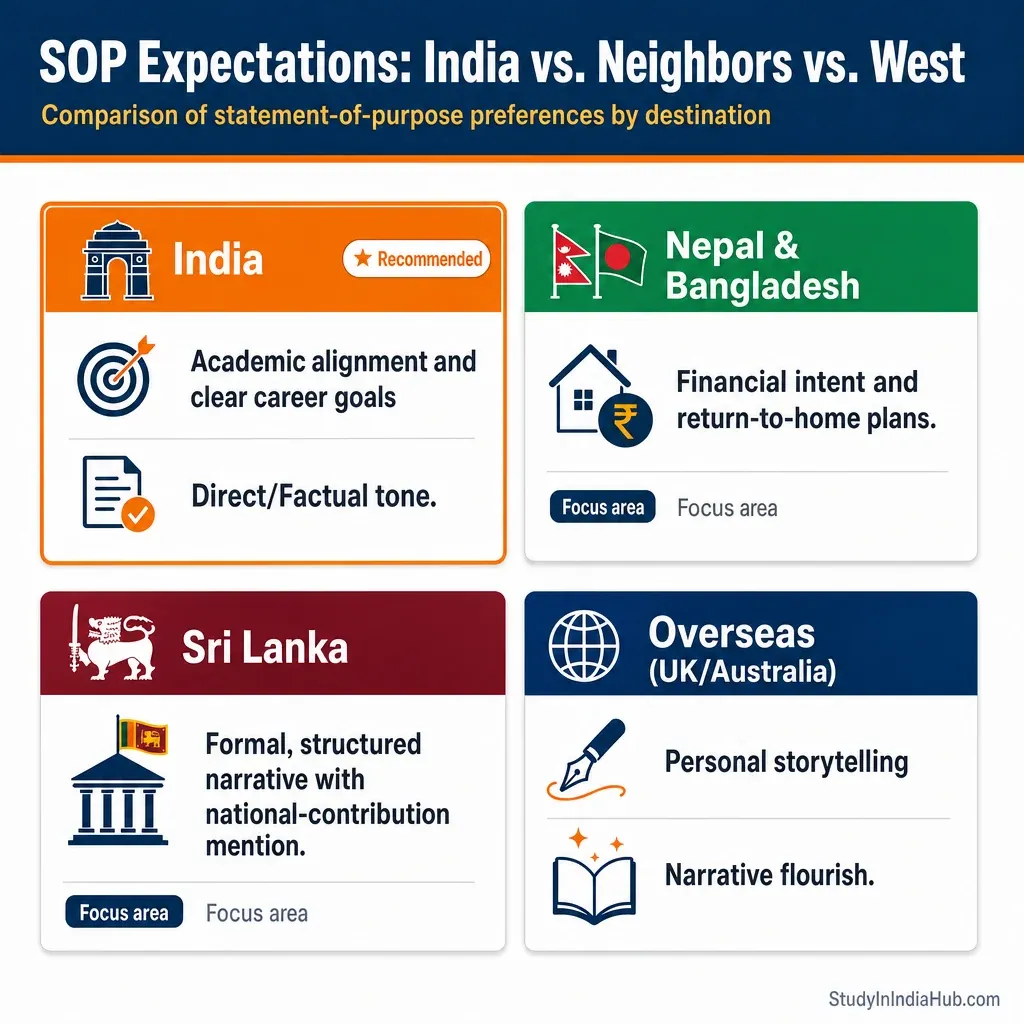
India also reads differently than the West. Western admissions readers tend to reward storytelling; Indian reviewers want precision and practicality instead. Remember too that they're working through 50 to 100 applications in a sitting, often with only 8 to 12 minutes per file on the first pass. An SOP that rambles or repeats itself loses you ground immediately, before anyone's even finished reading it.
Let's see what they're actually weighing, in practice:
Academic consistency
Your SOP should track the subjects your program actually demands. Many programs require specific 10+2 subject combinations (Physics, Chemistry, Biology, English) plus a minimum aggregate, sometimes with a lower threshold for reserved categories.
Genuine purpose
A line like "I aspire to pursue my education at your esteemed university" actively works against you. A reason tied to the program's actual coursework or its industry partnerships does the opposite.
Career reasoning
Name the role, the industry, or the specific path you're testing. "I wish to create an impact" tells a committee nothing they can evaluate.
Documentary precision
The Study in India Portal expects your SOP to match your submitted transcripts exactly. Any mismatch between what you claim and what your documents show can trigger real penalties.
Before You Write: Research and Self-Reflection
Knowing what committees look for only helps if you actually do the legwork first. Before you write a single sentence, two things need to happen: you research the program properly, and you sit with some honest self-reflection. This is the part that separates a strong SOP from a recycled template, because committees can tell almost instantly whether your stated reasons are specific to them or could apply to any program in the country.
Research the program and faculty
Start with the exact thing you're applying for: the precise program title or the department. Go through the curriculum properly: core courses, electives, dissertation requirements, and whether the program leans applied or research-heavy. From there, look at the faculty. Find two or three professors or research areas that genuinely overlap with what you want to do — what are they publishing, what are they actually running right now?
Applicants who name a specific piece of a professor's research and tie it to their own goals stand out immediately, partly because so few do it. For PhD applicants this step isn't optional, since PhD admission in India is tied to securing a research visa.
Reflect before you write
Now turn the lens inward. List your real accomplishments and attach numbers to them wherever you can; "led a team of three," "improved output by 15%," "ran a project that cut costs by 20%." Committees want evidence, not adjectives. Then write down your actual reason for wanting this specific program and not "I want to study abroad," but something rooted in your own history that explains why this program, specifically, makes sense for you.
If there's a gap in your record or a grade that doesn't fit the pattern; a career change or a rough semester, then decide now how you're going to address it.
How to Structure Your SOP
Think of a strong SOP as a detailed path and tackle it section by section. It moves through five parts in sequence: who you are and what you've studied, why this specific program, where you're headed, why now, and a close that ties it together. Top institutions like the IITs, IIMs, NMIMS, IISc, FTII; tend to run a notably rigorous review process for postgraduate and specialized programs, which makes this structure matter even more.
In building this guide, I reviewed more than 300 SOPs submitted to Indian universities across engineering, management, and the humanities, comparing ones that led to offers against ones that didn't, and cross-checking the patterns against published admissions criteria from a range of public and private universities. What follows reflects those patterns and not universal rules.
The Hook: Your opening paragraph
Your first paragraph has exactly one job: tell the committee why you are perfect for this program, right now. Don't just add a quote you found online, add a specific, real motivation story.
Most applicants open the same wrong way: "I have always been passionate about engineering," or "Education has been my priority since childhood." Admissions officers have read thousands of these openings, and they all blur into the same sentence. Compare that to something like: "When my undergraduate research on water purification could directly address the groundwater crisis in my district, I knew I needed specialized training, and your applied sustainability research aligned exactly with that goal." That's concrete. It answers the only question that matters in the first paragraph: why you, and why now.
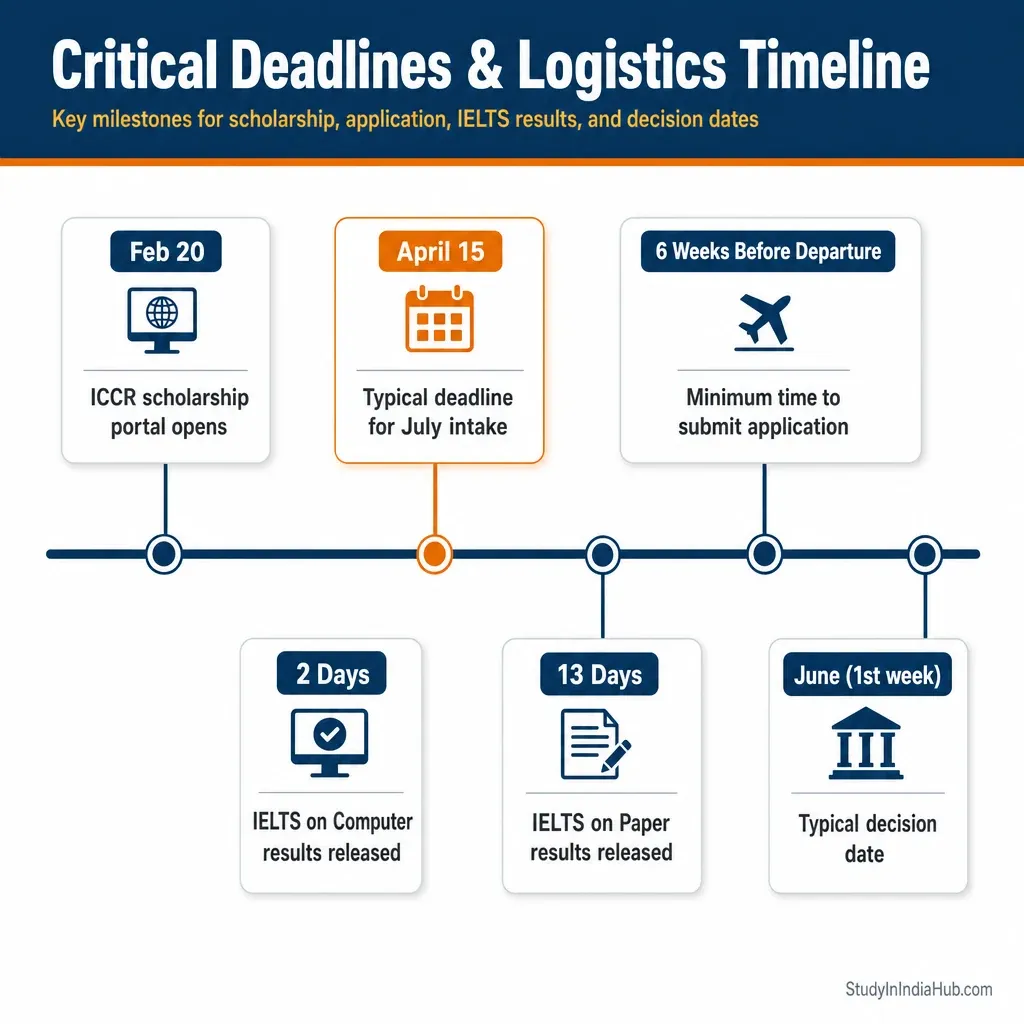
Keep this section to three or four sentences, around 100–150 words. And if your timeline involves a scholarship like ICCR, remember those portals tend to open earlier than general admissions, so your SOP needs to be genuinely ready well before the rest of your application is.
Academic Foundation: What You've Studied and Why It Matters
Your academic section should read as a clear progression of your most recent qualification first, then the specific skills it gave you, then how those connect to the program ahead. Pick two or three courses or projects that connect directly to what you're applying for. Indian universities cross-check this against the academic file they already have on you, so precision matters more than breadth here.
Applying to an MBA? Reference a statistics or strategy course where you actually led something. Applying to a research MSc? Lean on lab work and methodology specifics. Be exact because admissions officers verify this against transcripts as a matter of course. Aim for 250–300 words total here: specific, not exhaustive.
Why This Program, Why This University
This is where most SOPs fall apart. Lines like "Your faculty is excellent" tell a committee nothing. Name something real instead: a professor whose work overlaps with yours, a specialization track, a placement outcome you can point to.
Connect your goal to one specific feature of the program and one piece of evidence about the university. The program needs to explain what you'll actually study; the university needs to explain why it's the right place to study it. Name the exact department, lab, clinic, or faculty member that matches what you're after, and tie a specific professor's research, a practicum, or an internship pathway to your stated career plan.
For cost-sensitive specialized programs like hotel management, naming the actual annual charges, institutional fees plus the relevant regulatory body's fee; this signals financial readiness in a way vague statements don't. This matters more than it might seem, since student visa holders generally can't take outside employment, and even internships typically need university approval first. Keep this section to roughly 200–250 words, and make sure your stated reasoning holds up across the entire program, not just the opening semester.
Career Goals: Where You're Headed
Describe the career you're actually building: roles, industries, problems you want to work on. Not "I want to make an impact," but your short-term goals (the first one to three years after graduation). It should be concrete: for engineering, say whether you're aiming at product development, infrastructure, or research; for an MBA, name the sector: fintech, supply chain, consulting, whatever it actually is.
Your long-term vision, five to ten years out, should read as a natural extension of the short-term plan rather than an unrelated leap. You don't need an exact job title describing the scope of responsibility works just as well: "lead a team managing water resource projects across multiple states," for instance.
Then close the loop: explain specifically how this degree gets you there. A good test is whether a reader could repeat your goal back to you accurately after one read. If there's a regional angle, say a particular state is a hub for your target sector, cite that directly rather than gesturing at it. Keep this section to 150–200 words.
Conclusion and Commitment
End by tying everything together in a forward-looking close. Restate your commitment, mention the program once more by name, and finish with confidence: "I'm ready to bring [your strength] to [this program] to achieve [your short-term outcome]." Two or three sentences, around 100 words, is enough.
Length and Format
The length and format of your SOP matters more than you realize. Most programs expect somewhere in the 800–1,000 word range. Use a 12-point font, 1.5 or double spacing, and one-inch margins all around.
| SOP Component | Target Length | Key Focus |
|---|---|---|
| Introduction | 100–150 words | Personal motivation and the hook |
| Academic Background | 250–300 words | Technical skills and past achievements |
| Why This University | 200–250 words | Faculty research, International Student Cell, facilities |
| Career Goals | 150–200 words | Short-term and long-term placement objectives |
| Conclusion | ~100 words | Final summary and commitment |
If you're dealing with a career gap, a lower GPA, or a field switch, address it briefly within 50–100 words. Don't apologize for it and rather explain what you took from it and why you're applying now, with that context in hand.
Handling Tricky Situations: Career Switches, Gaps, and Low GPA
Here's a pattern worth knowing before you write: applicants who get in despite a career switch, a gap year, or a weak GPA almost never hide it. They explain it with a clear timeline, a reason tied to the program, and evidence that it's no longer the central story.
Career switches
State the transition plainly in one sentence: what you did before, what changed, why this program is the logical next step. If you don't explain the switch, the reader fills in the blank themselves, and that guess is rarely generous. Tie the change to a specific skill gap rather than a vague feeling: "while interning in my third semester at [company], I realized X" lands much better than "I found my passion." A vague "I want new opportunities" reads as uncertainty; a specific pivot reads as a plan.
Academic gaps
Keep the explanation tight and date-anchored: the month and year, the reason, and what you actually did during that time. A gap only becomes a red flag when the SOP stays silent about it and the reviewer sees the gap in your records regardless. If you used that time to meet an English-language requirement, it's worth knowing IELTS has shifted heavily toward computer-based testing, which is a useful detail to mention if it shows you were actively working toward the program.
Low GPA
Don't litigate the number as your transcript already shows it. Show the trajectory instead. A climb from a 2.8 first year to a 3.4 by graduation tells a better story than a flat 3.2 the whole way through. If you worked 20 hours a week to fund your education, say so. If your core major courses were strong while general requirements dragged the average down, point that out directly. The shared structure across all three situations is the same: state the fact plainly, explain what caused it, then show evidence you're prepared now. Not "I faced challenges," but something closer to: "my career change exposed a real gap in my industry knowledge, which is exactly why I'm pursuing this specialization here."
Formatting, Word Count, and Common Mistakes to Avoid
When looking for specifics, you can directly check out the university pages. Many Indian university portals specify an 800–1,000 word range explicitly. Coming in under 600 reads as under-considered; going past 1,200 usually signals an SOP that wasn't edited down. Some institutions have also started requiring an additional short essay alongside the SOP in recent admission cycles, so check your specific university's portal.
Three patterns show up again and again in rejected applications. One applicant to a Delhi University master's program opened with a stock line about a "love for learning" and lifted two sections nearly verbatim from the program brochure. It was flagged immediately for duplicated content and a complete absence of personal voice. Another ran roughly 400 words over the limit, burying a genuinely strong research focus under unrelated school anecdotes, which the committee read as poor editorial judgment rather than enthusiasm. A third named the wrong university entirely in the closing paragraph which is an easy mistake to make when reusing a draft across applications, and one that reads as carelessness regardless of how strong the rest of the SOP is.
Here is the format you should stick to:
| Feature | Standard Requirement |
|---|---|
| Word Count | 800–1,000 words (or your program's specified range) |
| Font | Times New Roman or Arial, 11–12 point |
| Spacing | 1.5 line spacing, 1-inch margins |
| File Format | PDF only — never .docx unless requested |
Export as a PDF to keep your formatting intact across devices: a .doc file can quietly shift your margins or break your layout, turning a clean 1,000-word SOP into something that reads as sloppy. Break the SOP into four or five clear sections — introduction, academic background, program fit, career goals and conclusion; each roughly 150–200 words. Remember that a dense, undivided block of text buries your strongest points right alongside your weakest ones.
Before you submit your SOP, have a quick scan at this checklist:
- [ ] Word count within range
- [ ] First paragraph contains a specific example
- [ ] Named the program and one specific course or facility
- [ ] Explained why this program
- [ ] Saved as PDF, formatting clean
- [ ] Answered every question in the university's prompt
If you would never utter a sentence to an admissions officer, remove it.
Final Checklist Before You Submit
Having gone through hundreds of SOPs before they were submitted, here's the one thing that consistently separates the SOPs that get read closely from the ones that get skimmed. The gap is usually decided in the final 48 hours, not in the first draft. Run through four checks, in this order: proofreading, coherence, authenticity, and university-specific fit.
Read your SOP out loud, sentence by sentence. If you stumble over a line, an admissions officer reading quickly will stumble too. This is often how students catch their own inconsistencies; a research-focused second paragraph that quietly shifts into an industry-focused fourth paragraph with no explanation connecting the two.
Pre-submission checklist
- Read it aloud and flag every sentence that feels rushed, vague, or repetitive.
- Check coherence — your academic background, your chosen program, and your stated goals should read as one connected argument, not three separate ones stitched together. Would a reader understand why you're applying right now, specifically?
- Name something concrete like a lab, an instructor, a course. Committees spot generic praise instantly. (One applicant named the wrong city for the campus entirely and that application went nowhere.)
- Double-check every factual claim: projects, test scores, work experience, all of it.
- Confirm your portal registration is complete before applying for your student visa as this step unlocks the rest of the process.
- Build in the timing buffer by submitting your visa application at least six weeks before you intend to travel.
Summing Up
If there's one takeaway, it's that a winning SOP isn't the one with the best writing, it's the one that's clearly impossible to copy-paste anywhere else. Every section above exists to prove the same underlying point in a different way: that you've actually done the research, that your goals are specific enough to be real, and that this program is the logical next step in a story that already makes sense.
Committees skim hundreds of SOPs in a sitting; the ones that get read twice are the ones that couldn't have been written about any other university. Write yours so that swapping the university's name would break the whole thing, and then read it out loud one last time before you hit submit.
Related guides
- How to Apply to Indian Universities as a Foreign Student (2026)
- Best Universities in India for International Students (2026 Rankings + Fees)
- Study in India for Nepali Students: Complete Guide 2027
- Study in India for Sri Lankan Students: Admissions, Fees & Visa (2027)
- What Is Student Life Like in India for International Students? (2026)