Accommodation Guide for International Students in India (2026)
This guide covers hostels, PGs, and apartments for international students by real costs by city, the booking sequence that avoids delays, and what the new penalties actually mean for you.


As an international student, planning to study in India, there's so much you need to figure out. Accomodation should be on the top of that list. After you have sorted out your college and city, finding the right accomodation should be your priority.
But finding somewhere to live in India is rarely the hard part of studying here; picking the wrong option, or picking the right one too slowly, is. This article walks through your three real housing choices, what they actually cost city by city, and the exact sequence to follow so a documentation mismatch doesn't quietly cost you your top hostel pick or delay your registration by weeks.
Your Housing Options at a Glance
Talking about housing options, there are three real options that exist, and which one fits depends mostly on how long you're staying and how much hassle you're willing to take. University hostels suit first-timers on tighter budgets who'd rather not deal with landlords at all. PGs or paying-guest arrangements work for anyone who needs to move in fast and wants meals handled for them. Rental apartments make sense if you're staying two-plus years and actually want your own space.
| Option | Best for | What to watch |
|---|---|---|
| University hostel | First-time arrivals, tighter budgets, mess support | ₹1,000–₹3,000/month or ₹40,000–₹2,50,000/year (Chanakya University); spaces fill fast |
| PG/private hostel | Quicker occupancy, furnished rooms, meals included | In Hyderabad, budget ₹4,000–₹6,000/month for food and utilities in shared housing (Wise) |
| Rental apartment | Longer stays, full privacy | Lease agreements, deposits, utilities, roommates — all on you |
What I would recommend is to start your hostel search the moment your admission offer lands. Students who apply within two weeks of acceptance get first pick of rooms. Support also varies a lot by university; for eg- at SPPU, the International Centre handles hostel assignment directly, while at the University of Mumbai it's managed department by department, so don't assume there's one central office to call.
Comparing University Hostels, PGs, and Apartments
University hostels are the safest, most budget-friendly choice for a first year. PGs get you settled fastest. Private apartments make sense if privacy matters more to you than convenience and you're comfortable handling paperwork and deposits yourself.
Most landlords who'll accept rent transfers expect you to have a local bank account first. As an international student, that typically means opening an NRO (Non-Resident Ordinary) account, which requires a valid passport, your student visa, your university acceptance letter, and proof of local address. Drop your KYC documents at a branch, complete in-person verification, and the account is usually live within a few business days. Choosing a hostel means the university absorbs electricity, water, and often meals into one fee. Go private, and all of that utility management becomes yours, which is exactly where that NRO account starts earning its keep.
| Feature | University Hostel | Paying Guest (PG) | Private Apartment |
|---|---|---|---|
| Cost (Annual) | ₹1,42,000 (triple, food+utilities) to ₹1,84,000 (double w/ bath) at Chanakya University | ₹1,00,000 – ₹1,80,000 | ₹1,50,000 – ₹3,00,000+ |
| Privacy | Low (shared rooms) | Low to medium | High |
| Meals | Usually bundled into fee | Often separate or optional | Self-managed |
| Security | High (24/7 warden, gate control) | Varies by owner | Depends on society/landlord |
| Ease of Booking | Easiest if university allocates | Faster than apartments | Slowest (agreement + deposit) |
| Best For | Freshmen / new arrivals | Budget-conscious / late arrivals | Postgrad / roommate groups |
Let's understand this difference in detail:
University Hostels
University hostels give you instant, clean address verification for your FRRO registration. A university hostel letter rarely causes delays, while a private rental agreement with even a minor name mismatch can stall things for weeks. At SPPU specifically, the International Centre bundles hostel assignment together with admissions and FRRO support for a population of roughly 14,000 international students from over 100 countries. Seats near campus go fast, and once intake season is underway, you're picking from whatever's left rather than what you actually wanted. Room type changes the total cost quickly too; a shared room runs noticeably cheaper than a private one with its own bathroom, and that gap only grows as privacy increases.
Paying Guest (PG) Accommodations
A PG sits in between the other two options. You get a furnished bed in a supervised home, flexible meal arrangements, and a faster move-in than an apartment. Quality swings widely from one PG to the next, so check the lease terms, meal schedule, and damage deposit before you pay anything. And confirm upfront that the owner will provide the Form C you'll need for police registration as this is easy to forget to ask about and genuinely necessary.
Private Apartments
Apartments make the most sense if you're splitting costs with roommates or staying long-term. Expect a deposit of one to three months' rent, and treat that money as effectively locked away until move-out unless the contract spells out exactly what triggers deductions, when the refund happens, and how utilities get split. Here, it's worth remembering that student visa holders can't take outside work in India, so whatever budget you start with is the budget you're working with for the duration.
How Much Accommodation Costs by City
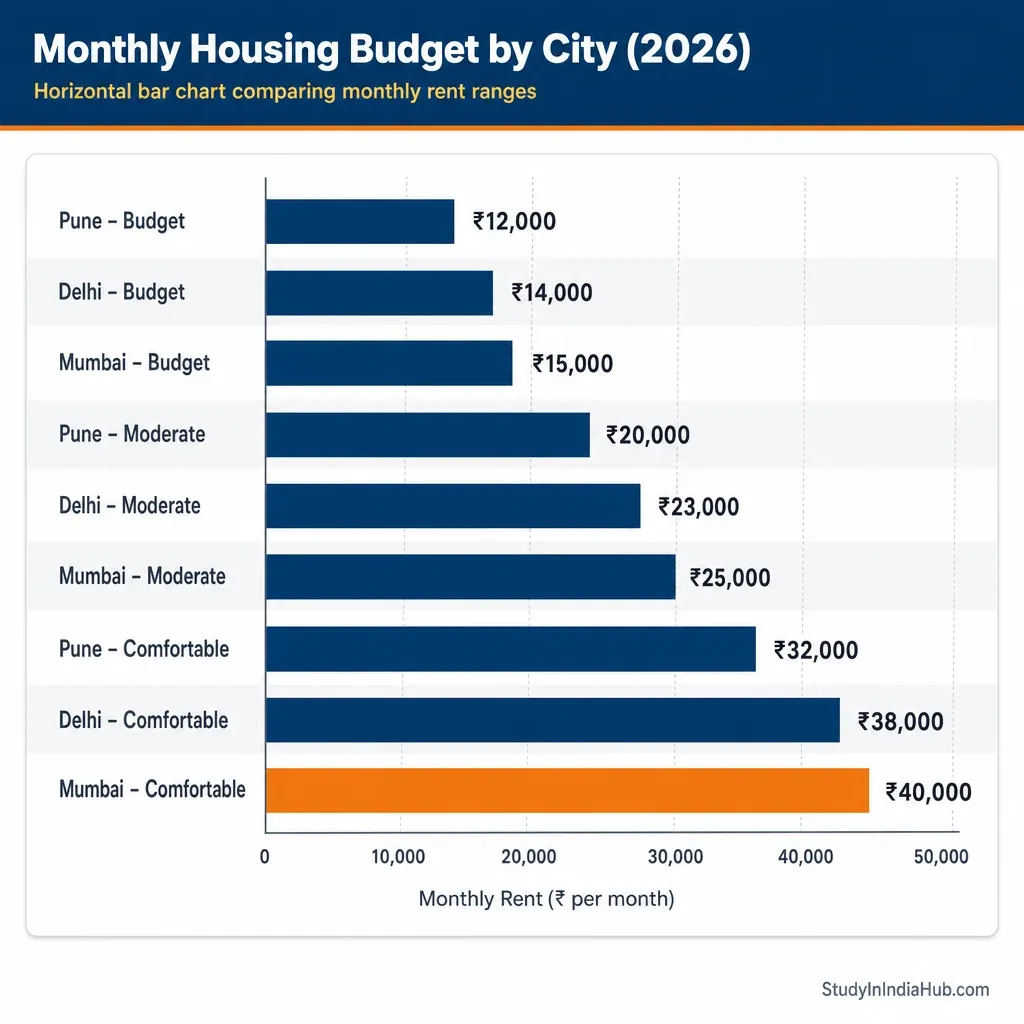
Monthly accommodation for international students in India runs roughly ₹12,000 to ₹40,000, and the gap between the cheapest and most expensive city can run as high as ₹28,000 a month. The tier you choose moves your total more than the city itself does. Each major city offers all three: budget usually means shared accommodation or a basic PG, moderate gets you an individual room within a PG or hostel, and comfortable means a private apartment or a high-end PG.
Where each city lands
A comfortable life in Mumbai is the most expensive option, largely because of genuine real estate scarcity. Students near NMIMS, SNDT, or Mumbai University often see rent jump by ₹5,000–₹8,000 a month just for proximity. So, live close and pay for it directly, or live farther out and pay for it in commute time instead.
Delhi typically runs ₹7,000 to ₹12,000 a month for rent alone, with another ₹3,500–₹8,000 for food and mess plans and ₹1,000–₹3,000 for transport. At the budget end, you're usually sharing a room or living somewhere off North Campus.
Pune is where your money stretches furthest. Housing here runs 15–20% below Delhi or Mumbai, and the infrastructure around SPPU, Symbiosis, and Savitribai Phule is solid enough that the savings don't come at the cost of quality. One student from Kathmandu chose Pune over Mumbai specifically for this reason and ended up saving roughly ₹3,00,000 in housing costs across a two-year master's program.
Budget your first month separately from the rest
Your first month needs its own line item: deposits (usually one to two months' rent upfront), food, a local SIM, and general settling-in costs. Plan for ₹60,000–₹80,000 in that first month specifically, then expect things to settle into a more normal monthly rhythm after that.
Most international students we work with land somewhere around ₹7–10 lakh annually in total costs. If you're applying through ICCR, double-check the current A2A portal dates each cycle, since scholarship timing has a way of reshaping your entire budget around it, so always confirm the latest figures directly with your university's international office rather than relying on a single source.
Finding Housing Near Campus in Mumbai and Pune
The right neighborhood depends entirely on your university and how much commute you're genuinely willing to do everyday. In both cities, the goal is the same: live close enough that registration, banking, and getting to class don't eat your whole day.
Pune: Clearer neighborhoods, shorter commutes
Students near SPPU tend to cluster in Aundh, Baner, Viman Nagar, Kothrud, Erandwane, and Shivajinagar; all areas with established PG networks and the kind of everyday infrastructure international students actually need. A typical one-way commute in Pune runs around 44 minutes for roughly 16 kilometers. Start with SPPU's International Centre regardless of where you end up living as it handles hostel assignment, FRRO support, health coverage, and even airport pickup from Pune Airport. Whatever you choose, confirm that your landlord will provide police-verification documents before any deposit changes hands.
Mumbai: Plan around the commute first
Mumbai's housing market moves faster and costs more across the board. For Mumbai University's Fort campus, Colaba or Marine Drive are options, though pricier ones; for the Kalina campus, Santacruz and Kurla tend to be more realistic. Vile Parle, Matunga, and Powai are also popular among students. What looks close on a map can still mean over an hour by local train during rush hour, and a "cheaper" suburb can quietly cost you ₹3,000–₹4,000 a month in transport plus two hours a day you didn't budget for.
As a rough rule, "near campus" in India means a 20–40 minute commute by local transit, ideally within 3–5 kilometers. Past about 8 kilometers, the commute starts eating noticeably into your day.
How to Book Accommodation Step by Step
I have broken down step-by-step on how you can book the right accomodation for yourself. Work through this in order: apply through your university's hostel portal first, then look at vetted off-campus options if needed, and only ever pay once the lease, deposit terms, and landlord's identity are all confirmed.
Top 5 Booking Mistakes to Avoid
Most accommodation problems trace back to a small set of avoidable errors: booking through unverified social media posts or WhatsApp groups where photos rarely match reality; paying in full before a video tour; skipping over the fine print on deposits, refunds, and notice periods; agreeing to anything without a written contract; and choosing a location without actually checking the real commute and transit options.
Step 1: Apply Through the University Hostel Portal
Most universities start allocating hostel rooms two to three months before intake, and spots fill before the semester even starts. Apply the same day your admission is confirmed, as students who wait for visa approval consistently lose out on the best rooms. Log into your institution's international student portal (SPPU's International Centre is one example) and submit the hostel application there. Processing usually takes five to ten business days, after which you'll get an email with your allocation, payment details, and deposit deadline. At some institutions, like BITS Pilani, hostel fees run around ₹36,000 per semester, and once you have that allocation letter in hand, both your move-in and your FRRO registration get noticeably easier.
Step 2: Have These Documents Ready
| Document | Notes |
|---|---|
| Passport | First and last four pages, self-attested |
| Student visa | With immigration endorsement |
| Admission letter | From your institution |
| 4 passport photos | — |
| Proof of funds | Bank statement covering fee + deposit |
| AIU equivalency | If required by your board (see below) |
Ensure that you have scanned all documents clearly. A blurry phone photo can add two to three weeks to processing on its own, so upload proper PDFs from the start. On equivalency specifically: the UAE Secondary Certificate and Bangladesh HSC are recognized as equivalent to Class 12 by the Association of Indian Universities, while CBSE and IB are accepted directly. Some boards may still need a separate AIU Equivalency Certificate; one student we worked with lost their preferred room simply because that certificate took 11 days to come through instead of the 5 they'd planned for.
Step 3: Pay the Deposit and First Fee
The university will send a payment invoice covering your first term's fee plus a refundable security deposit, usually equal to one or two months' rent. Pay by bank transfer to the university's account and keep the receipt as you'll need it both for FRRO registration and for opening your NRO account. Pay on time: one student's payment cleared four days past the deadline, and her room was bumped to the waitlist as a direct result.
Step 4: Off-Campus - Use Vetted Platforms Only
If hostel spots are gone, stick to established platforms like NoBroker or 99acres rather than random listings on Facebook or WhatsApp groups. A price well below the going local rate is a fraud signal, not a deal. Before sending any money, ask for the full address, the owner's ID, a draft of the rental agreement, the deposit terms, the move-in date, and the refund conditions, and get a video walkthrough of the actual room.
Step 5: Register on e-FRRO
This is the step where the new rules actually matter, so read this section closely even if you skip the rest. Once you arrive, you're required to register through e-FRRO - and as of the June 1, 2026 rule change, the old approach of "register late and pay a small fine" no longer holds the same way it used to for longer stays. Treat the 14-day window as a hard deadline, not a soft one.
Settling In: Your First Week Checklist
Once arrived, get your communication sorted first, then your documentation. A single small mistake in either order can hold up everything else that follows.
- Get a local SIM from an authorized store, bringing your passport, a copy of your visa, a passport photo, and proof of your Indian address. Activation usually takes 15–30 minutes.
- Open your NRO bank account using your passport, student visa, four photos, and your university enrollment certificate.
Final Thoughts
Now that you have a better idea about the accommodation options and the route you want to opt for, something to note: strip away the paperwork and the city comparisons, and housing in India really comes down to one timing question: are you moving fast enough to get ahead of the documentation?
Apply to your hostel the day your admission is confirmed, not the day your visa clears. Check every document against your passport before you board a flight, not after a registrar's office flags it. And treat the 14-day FRRO window as a real deadline now more than ever, since the cushion that used to exist there has genuinely gotten smaller. Get the timing right, and the rest of this is just logistics you work through one item at a time.
Related guides
- Best Universities in India for International Students (2026 Rankings + Fees)
- Study in India for Nepali Students: Complete Guide 2027
- What Is Student Life Like in India for International Students? (2026)
- MBA in India for International Students: Best Colleges, Fees & ROI (2026)
- Is India a Good Place to Study for International Students? (Honest Review 2026)