University of Mumbai: Best Engineering University for Nepali Students without IITJEE (2026): Includes VJTI, SPIT
If you are a Nepali student who wants to become an engineer in India, the honest first question is not "IIT or University of Mumbai?" It is: "Can I clear…

If you are a Nepali student who wants to become an engineer in India, the honest first question is not "IIT or University of Mumbai?" It is: "Can I clear JEE Advanced?" Everything else follows from that one answer. This guide lays out the real trade-off - so you can pick the route that actually fits your marks, your budget and your plans back home.
The one fact that decides the IIT question
There is exactly one door into an IIT, and it is JEE Advanced. For 2026:
- Foreign-national candidates (including Nepali citizens) can register for JEE Advanced directly - you are not required to sit JEE Main first.
- The exam is now held at centres in Nepal, so you can take it in Kathmandu without travelling to India.
- Foreign-national seats are supernumerary - up to 10% of a programme's seats at each IIT, over and above the Indian intake.
- Tuition for a foreign national at most IITs is modest: roughly USD 2,000–4,000 a year, plus hostel and mess.
So cost is not the barrier at an IIT. The barrier is the exam. JEE Advanced is one of the most competitive undergraduate tests in the world, and the foreign quota does not remove that - you still have to clear the paper. If you can, an IIT is a superb choice, and you should take it. This guide is for the far larger group of capable students who do not or can not sit for JEE Advanced but still want a recognised Indian engineering degree.
Where the University of Mumbai fits
The University of Mumbai is a UGC-recognised public university, and its engineering degrees are earned at its long-established affiliated engineering colleges across Mumbai - India's financial capital. Two things matter most for a Nepali family:
- The degree is recognised for equivalence in Nepal, so it counts for jobs and further study when you return.
- You do not sit a national entrance gauntlet. Admission for international students runs through a single-window International Admission Desk, on merit from your 10+2 marks.
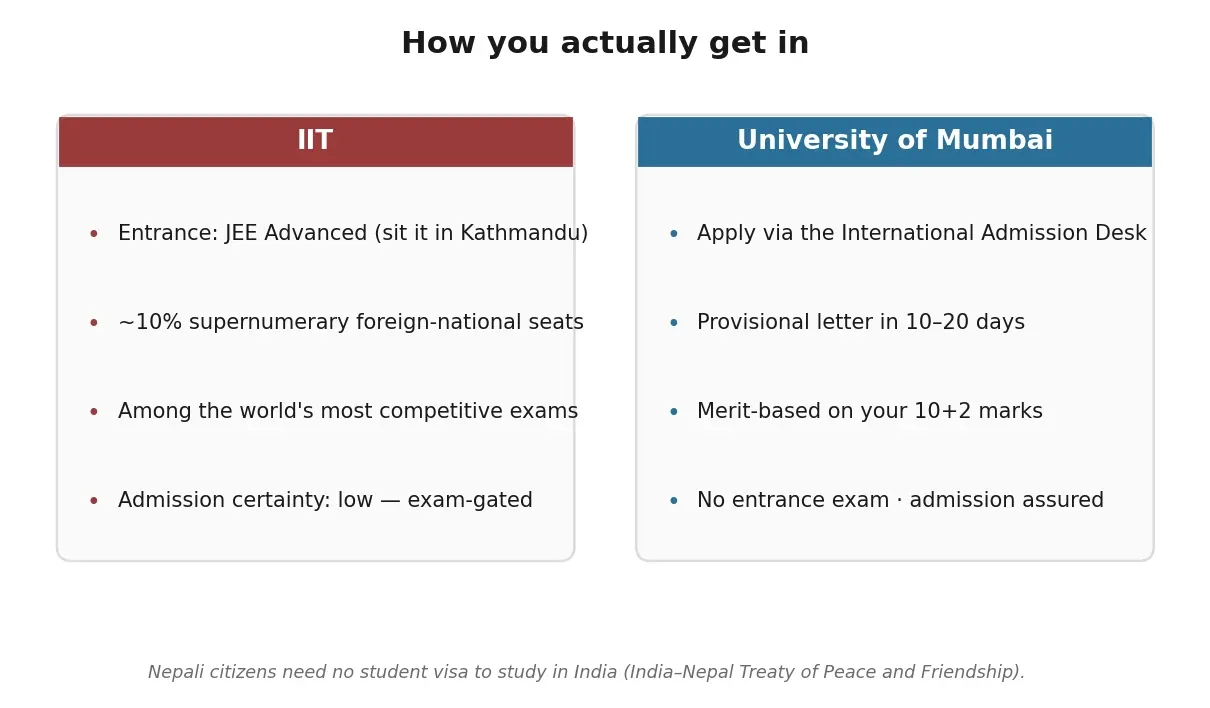
IIT vs University of Mumbai — side by side
| IIT | University of Mumbai | |
|---|---|---|
| How you get in | JEE Advanced only | International Admission Desk, merit on 10+2 |
| Entrance exam | Yes - among the world's toughest | None |
| Admission certainty | Low - exam-gated | High - assured for eligible applicants |
| Annual tuition (approx.) | USD 2,000–4,000 (foreign national) | ~₹1,00,000 (~USD 1,200) |
| Seats for internationals | ~10% supernumerary, per programme | Open international quota |
| Recognised in Nepal | Yes | Yes |
| Student visa for Nepali citizens | Not required (India–Nepal Treaty) | Not required (India–Nepal Treaty) |
The money - and the money before the money
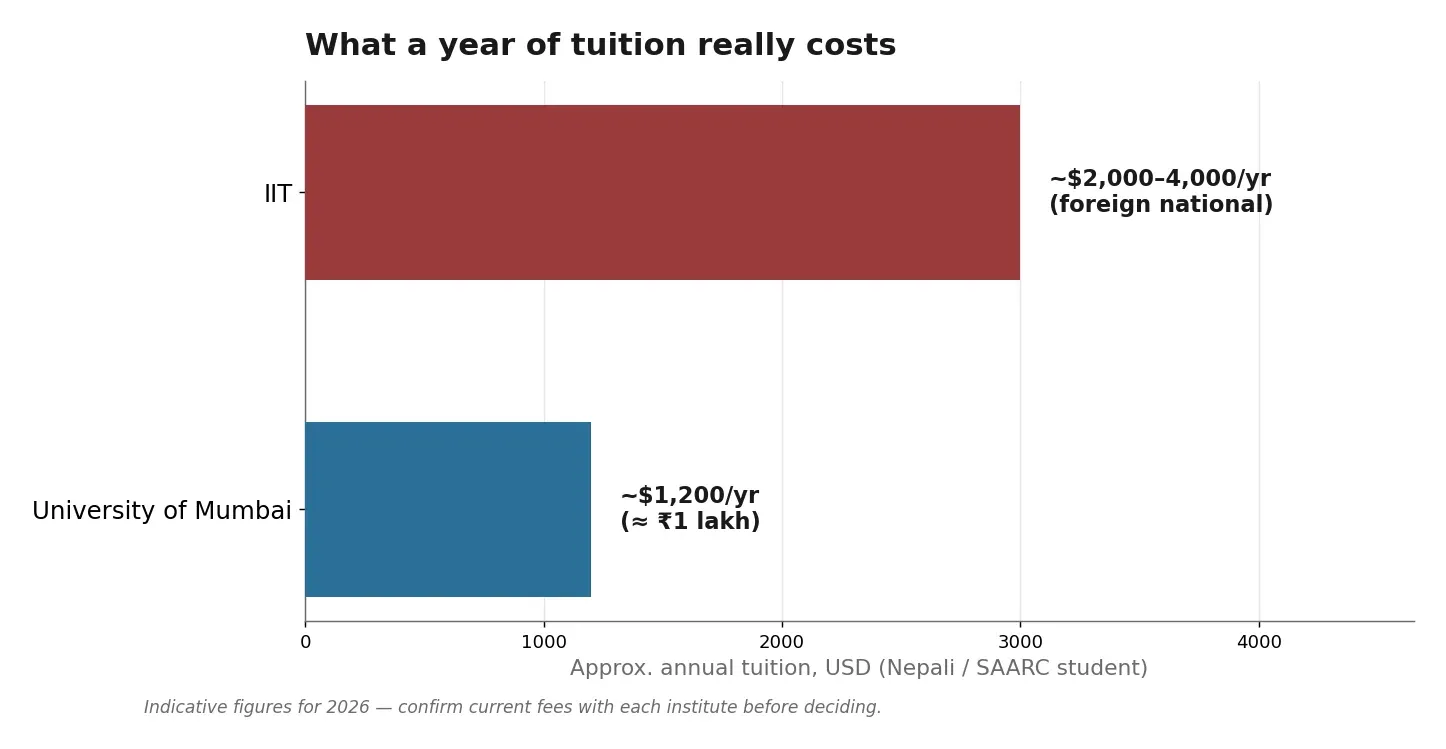
Tuition at the University of Mumbai for an international engineering student is about ₹1,00,000 a year (~USD 1,200), plus a one-time ₹4,728 per-course eligibility fee and a USD 1,000 application fee. An IIT foreign-national seat is roughly USD 2,000–4,000 a year - higher, but not the deciding factor.
The cost people forget is the cost of trying for an IIT: one to two years of JEE coaching, materials and repeat attempts, with no guarantee of a seat at the end. For most families, that spend - with an uncertain result - is the real expense. The University of Mumbai route has no entrance exam and no coaching bill.
Proof: a Nepali engineer who took this route
Garima Acharya studied engineering at the University of Mumbai (2016–2020). She was admitted through the international desk, completed her degree without an education loan, and is working in Nepal today. Her classmate Bivek Joshi did the same on the finance side (2016–2019) and is also back home, employed, loan-free.
The point is not that Mumbai is "better than IIT." It is that a recognised Indian engineering degree, finished without debt and leading to a job in Nepal, is a genuinely strong outcome - and it was reachable without clearing JEE Advanced.
Who should choose what
- Aim for an IIT if you are a top-percentile student, you can commit to JEE Advanced preparation, and you want the IIT brand and research ecosystem. If you can clear it, take it.
- Choose the University of Mumbai if you want a recognised engineering degree with assured admission, predictable low fees, a big-city placement market, and no dependence on one high-stakes exam.
How to apply to the University of Mumbai (international students)
- Register on the International Admission Desk portal and submit your 10+2 marksheets.
- Pay the ₹4,728 per-course eligibility fee; you receive a provisional admission letter in about 10–20 days.
- Pay the USD 1,000 application fee.
- A committee allots your engineering college on merit. Because Nepali citizens need no student visa under the India–Nepal Treaty of Peace and Friendship, you can travel and enrol without a consular process.
Frequently asked questions
Can a Nepali student get into an IIT without JEE Advanced?
No. IIT undergraduate admission is only through JEE Advanced; IITs are not part of the DASA quota. Foreign nationals may register for JEE Advanced directly (no JEE Main), but they must still clear the exam.
Is a University of Mumbai engineering degree recognised in Nepal?
Yes. The University of Mumbai is a UGC-recognised public university and its degrees are accepted for equivalence in Nepal for employment and further study.
Do Nepali students need a visa to study engineering in India?
No. Under the India–Nepal Treaty of Peace and Friendship, Nepali citizens do not require a student visa to study in India.
How much does engineering at the University of Mumbai cost for a Nepali student?
About ₹1,00,000 per year (~USD 1,200) in tuition, plus a ₹4,728 per-course eligibility fee and a one-time USD 1,000 application fee — well below what a year of JEE coaching plus an IIT seat typically costs.
Which is better for a Nepali student — IIT or University of Mumbai?
If you can clear JEE Advanced, an IIT is an excellent choice. If you cannot — which is true for most students — the University of Mumbai gives you a recognised engineering degree with assured admission and low fees.
Reviewed by Pratik Gandhi, international education consultant for Indian universities.
Related guides
- Engineering in India for Nepali Students: Colleges, Fees & Admission
- Top Universities in Mumbai for International Students
- IIT vs University of Mumbai: Which University Is Better for Nepali Students?
- NIT vs University of Mumbai: Best Engineering College for Nepali Students
- IIT vs SPPU: Which Is Better for Nepali Students to Study Engineering?