NIT vs University of Mumbai: Engineering institute for Nepali Students (2026)
Unlike an IIT, an NIT is genuinely reachable for a Nepali student without cracking JEE Advanced — through the government's DASA scheme. So the…

Unlike an IIT, an NIT is genuinely reachable for a Nepali student without cracking JEE Advanced — through the government's DASA scheme. So the NIT-versus-University-of-Mumbai choice is a real, close comparison, and it comes down to three things: the entrance rank you can get, the fees you can afford, and how certain you want your admission to be. Here is the honest breakdown for 2026.
How a Nepali student actually gets into an NIT
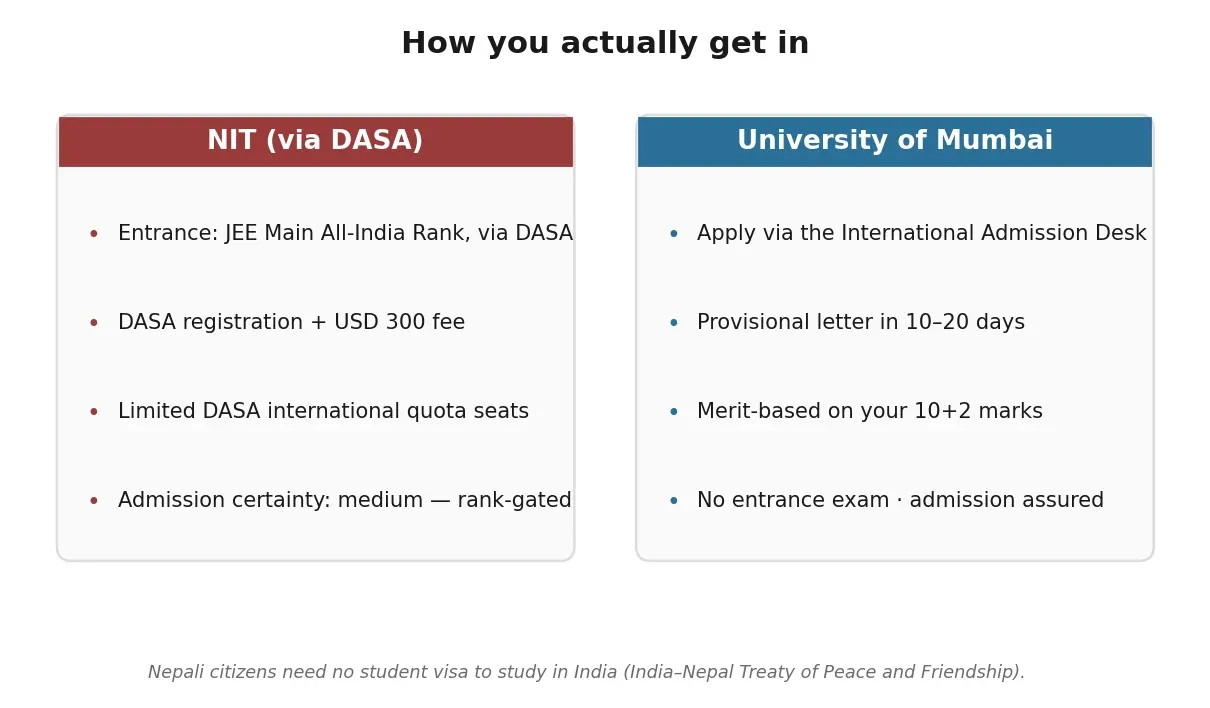
NITs admit international students through DASA (Direct Admission of Students Abroad). For 2026:
- DASA undergraduate admission is based on your JEE Main All-India Rank - so you still sit a competitive national exam, just not JEE Advanced.
- Because Nepal is a SAARC country, a Nepali student who passed the qualifying exam in Nepal falls in the DASA (SAARC) category, with a 50% tuition waiver.
- Even after the waiver, SAARC tuition is about USD 3,562 a year, plus a USD 300 registration fee and hostel/mess charges.
- DASA seats are limited, and allotment depends on your rank.
An NIT is a premier, well-regarded engineering institute — if you have a strong JEE Main rank and the budget, it is an excellent choice.
What the University of Mumbai offers instead
The University of Mumbai is a UGC-recognised public university whose engineering degrees, earned at its affiliated colleges across Mumbai, are recognised for equivalence in Nepal. The differences that matter:
- No entrance exam and no rank cut-off — admission runs through the International Admission Desk on your 10+2 merit.
- Assured admission for eligible applicants, with a provisional letter in 10–20 days.
- Lower fees — about ₹1,00,000 a year (~USD 1,200), roughly a third of DASA-SAARC tuition.
Side by side
| NIT (via DASA) | University of Mumbai | |
|---|---|---|
| How you get in | JEE Main All-India Rank, via DASA | International Admission Desk, merit on 10+2 |
| Entrance exam | Yes — JEE Main | None |
| Admission certainty | Medium — rank- and seat-gated | High — assured for eligible applicants |
| Annual tuition (approx.) | ~USD 3,562 (DASA SAARC) + USD 300 reg | ~₹1,00,000 (~USD 1,200) |
| Recognised in Nepal | Yes | Yes |
| Student visa for Nepali citizens | Not required (India–Nepal Treaty) | Not required (India–Nepal Treaty) |
The cost gap is real
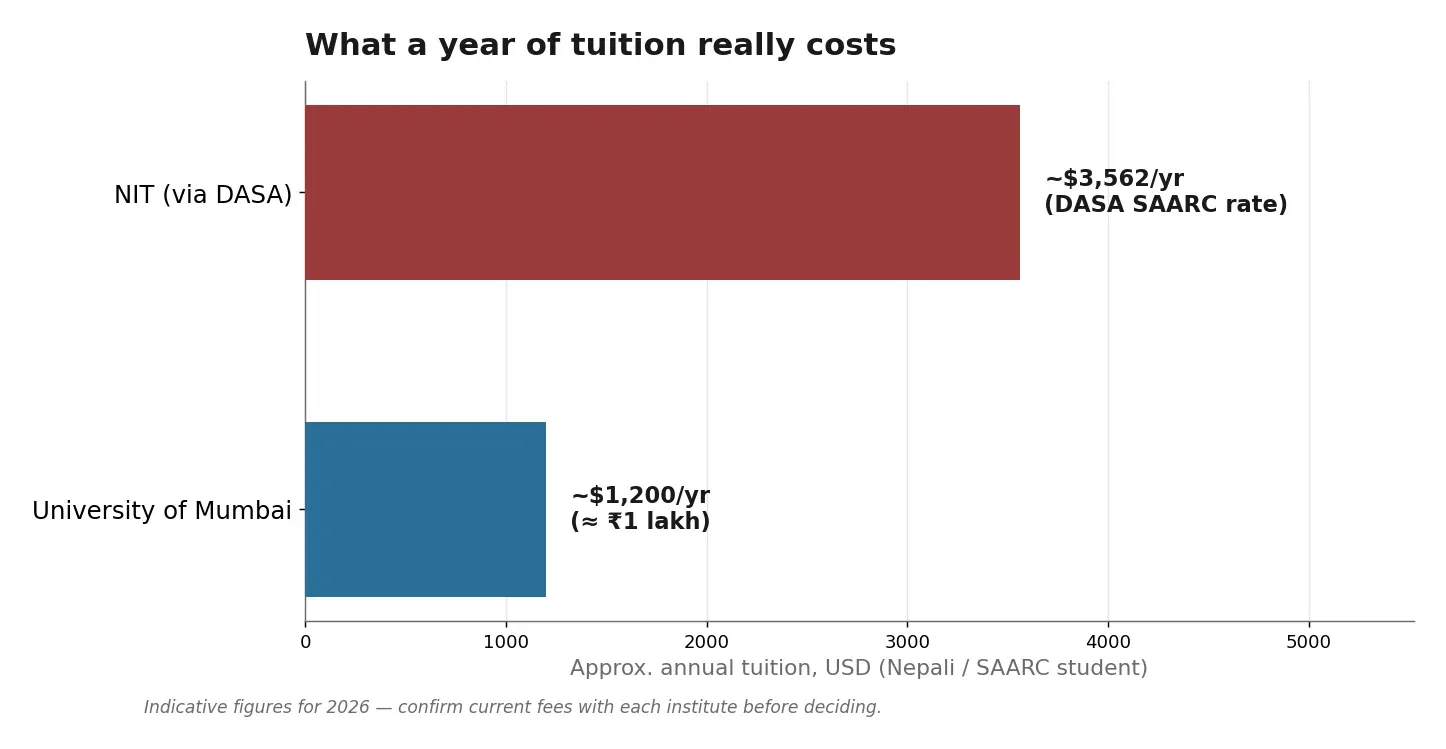
Even at the discounted SAARC rate, an NIT costs roughly three times the University of Mumbai — before hostel, mess and the USD 300 registration fee. For families weighing four years of spending, that gap is significant. And an NIT still asks you to place well in JEE Main first, with no guarantee of a seat.
Garima Acharya took the University of Mumbai route: engineering (2016–2020), admitted through the international desk, graduated without an education loan, and working in Nepal today. Her classmate Bivek Joshi did finance on the same terms. Both are Edulab-managed students who agreed to be named.
Who should choose what
- Aim for an NIT if you can secure a strong JEE Main rank and your family is comfortable with roughly 3× the fees. NITs are excellent institutes and worth it if you clear the bar.
- Choose the University of Mumbai if you want assured admission, the lowest predictable fees, and no dependence on a JEE Main rank or a limited DASA seat pool.
How to apply to the University of Mumbai
- Register on the International Admission Desk portal with your 10+2 marksheets.
- Pay the ₹4,728 per-course eligibility fee; a provisional letter follows in 10–20 days.
- Pay the USD 1,000 application fee; a committee allots your engineering college on merit.
- Nepali citizens need no student visa (India–Nepal Treaty), so there is no consular process.
Frequently asked questions
Can a Nepali student get into an NIT without JEE Advanced?
Yes - NITs admit international students through the DASA scheme based on a JEE Main All-India Rank, not JEE Advanced. Nepal being a SAARC country, you may qualify for the DASA (SAARC) category with a 50% tuition waiver.
How much does an NIT cost for a Nepali student?
Around USD 3,562 a year at the DASA SAARC rate, plus a USD 300 registration fee and hostel/mess charges.
How much cheaper is the University of Mumbai?
About ₹1,00,000 a year (~USD 1,200) - roughly a third of DASA-SAARC NIT tuition, with no entrance exam.
Do Nepali students need a visa to study engineering in India?
No. Under the India–Nepal Treaty of Peace and Friendship, Nepali citizens do not require a student visa.
Which is better, NIT or University of Mumbai?
If you have a strong JEE Main rank and the budget, an NIT is an excellent institute. If you want assured admission and lower fees without a rank cut-off, the University of Mumbai is the better fit.
Reviewed by Pratik Gandhi, international education consultant for Indian universities.
Related guides
- Engineering in India for Nepali Students: Colleges, Fees & Admission
- Top Universities in Mumbai for International Students
- NIT vs University of Mumbai: Which University Is Better for Nepali Students?
- IIT vs University of Mumbai: Best Engineering College for Nepali Students
- NIT vs SPPU: Which Is Better for Nepali Students to Study Engineering?