Is India Safe for International Students? Safety Guide 2026
India hosts 46,000+ international students yearly — and its crime index (44.2) is actually lower than the US, UK, and Australia. Here's what safety really looks like on the ground, city by city, for international students in 2026.

Every year, tens of thousands of students from Nepal, Bangladesh, Sri Lanka, the UAE, and beyond choose India for their undergraduate or postgraduate studies. And the first question most of them ask: Is it actually safe?
The honest answer is: yes, for most students, most of the time, with preparation. India isn't uniquely dangerous, but it isn't frictionless either. Safety here depends less on the country as a whole and more on which city you're in, where you live within that city, and how you get around after dark. Students who thrive approach safety as a habit, not a fear.
We've worked with recent international students from across South Asia and beyond, cross-referenced official data, and built this guide around what actually matters on the ground and not just what looks reassuring in a brochure.
How India Actually Compares on Safety (The Numbers Might Surprise You)
Before diving into practicalities, it's worth addressing the elephant in the room: the perception that India is more dangerous than Western countries.
The data tells a different story. On Numbeo's Crime Index; where 40–60 is considered moderate; India scores approximately 44.2. That places it lower than Australia (47.5), the UK (48.3), and the United States (49.2). The US murder rate is estimated at around 4.0 per 100,000 people.
| Country | Crime Index (Numbeo) |
|---|---|
| India | ~44.2 (lowest of the four) |
| Australia | ~47.5 |
| United Kingdom | ~48.3 |
| United States | ~49.2 |
Source: Data Pandas
India also operates the second-largest higher education system in the world, with over 800 universities. According to the latest All India Survey on Higher Education (AISHE), the country hosts approximately 46,000–49,000 international students. Nepal accounts for the largest share (~28%), followed by Afghanistan, Bangladesh, the United States, and the UAE. The largest concentrations are in Karnataka and Maharashtra; both states with well-established campus communities and peer networks that ease the transition.
India vs. the UK, US, and Australia: The Full Picture
Safety is only one part of the equation. Here's how India stacks up across the factors that matter most to international students:
| Factor | India | Australia | UK | US |
|---|---|---|---|---|
| Annual tuition (engineering) | US$3,000–5,000 | ~AUD 29,710 (~US$19,500) (IDP) | £15,000–25,000 (~US$19,000–31,500) | US$25,000–45,000 |
| Monthly living cost | US$200–400 | ~US$1,300–2,000 | ~US$1,250–1,875 | US$1,200–2,500 |
| Crime Index (Numbeo) | ~44.2 (moderate) | ~47.5 (moderate) | ~48.3 | ~49.2 |
| Student visa | No interview; valid for full course | Annual renewal | Annual financial proof | F-1 tied to full-time enrollment |
Crime Index source: Data Pandas
Safest Cities for Students: Mumbai, Pune, and Beyond
City choice is probably the single biggest lever you have over your safety experience. Here's a grounded look at the main options:
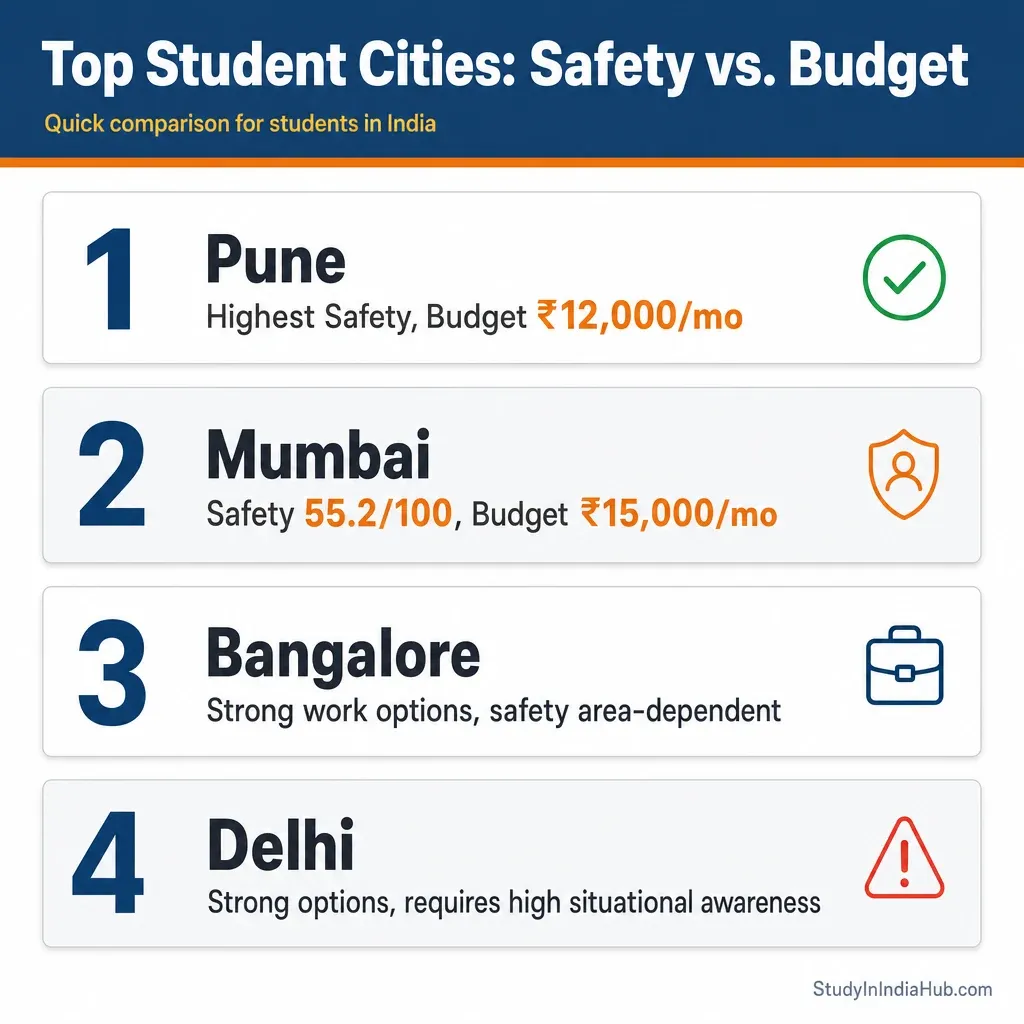
Pune is where most students we've spoken to feel most comfortable, and it's easy to see why. The city is built around its student population and its local businesses, landlords, and auto drivers are used to international residents. You can find quality shared accommodation for ₹8,000–12,000/month, and the areas near major universities are well-connected and relatively safe even at night.
Mumbai never really sleeps, which cuts both ways. Transport is available at 3 AM, but the higher cost of living pushes many students into cheaper, less safe areas on the city's outskirts; often adding 2 hours of commuting daily. If you go to Mumbai, budget realistically for centrally located accommodation.
Delhi and Bangalore both offer exceptional academic and internship opportunities, but require more active situational awareness. In Delhi, look for accommodation in "colonies" with active Resident Welfare Associations (RWAs) managing gated access. In Bangalore, the tech corridor areas are generally fine; more isolated neighbourhoods less so.
Safety is these cities also depend on whether on you choose to live inside the campus or off campus.
Campus Security vs. Living Off-Campus
On-campus housing almost always wins on safety. University hostels typically offer 24/7 gated access, CCTV surveillance across the campus perimeter, and a dedicated international student cell for support. Savitribai Phule Pune University (SPPU), for example, hosts approximately 14,000 international students from over 100 countries and runs a dedicated International Centre.
Off-campus accommodation in Delhi runs ₹7,000–₹12,000/month for student-suitable rooms. Cheaper often means less secure with no security personnel, limited CCTV, no clear point of contact after 6 PM.
Before you pay any deposit, ask these questions:
- Can I see photos of the actual room and bathroom (not stock images)?
- Is there 24/7 security and what are the gate hours and visitor rules?
- Where is the nearest CCTV camera?
- Who handles complaints or emergencies after 6 PM?
- How far is it from my academic building, in metres, by the actual route?
Women's Safety: What Female Students Should Know
In India, female students encounter genuine risks, but these are manageable and not exclusive to this nation.
The three situations that come up most consistently in student communities: crowded public spaces, solo travel at night, and poorly-lit areas near accommodation. These aren't unique to India, but they're worth planning around specifically.
What students consistently recommend:
- Use app-based taxis at night, not street cabs. The ability to share your trip in real time changes the risk profile significantly.
- Choose accommodation actively. Female-only PGs exist in most student cities, and the better hostels have 24/7 security and strict entry logs. Staying in a high-traffic area near a metro station beats a cheaper, quieter spot.
- Connect with senior students before you arrive. Women's groups and international student networks at most universities can give you neighbourhood-specific advice that no general guide can match.
- Know your university's women's cell or grievance officer. That's your first point of contact if anything happens on or near campus.
PhD students and research scholars are also permitted to bring dependents on applicable visa categories, which provides an additional layer of personal support for longer stays.
Getting Around Safely
Transport is where most students feel the gap most acutely, especially in the first few weeks. Getting around can get a little challenging especially if you are new and not familiar with transportation means.
The practical hierarchy:
- Ride-hailing apps (Uber/Ola): Always use the "Share Trip" or trip-sharing feature on these apps. Book within the app so you have the driver's name, vehicle number, and a fare record.
- Metro and city buses: Public transport is also a good option as they have fixed routes, fixed prices, no haggling. Women's coaches on metro systems in Mumbai and Delhi, and women-only seats at the front of most city buses, are available and worth using during peak hours.
- Street taxis: Use only as a last resort, and only when you've confirmed the rate and seen the car before getting in.
Budget ₹1,000–₹3,000/month for daily transport depending on your city. The ₹200–300 you save by flagging down an unregistered cab at night isn't worth it.
For longer intercity journeys, airfares on routes like India–Nepal are often more competitive than they appear. Air India, IndiGo, Nepal Airlines, and SpiceJet run up to 70 flights per week on some routes. A cheap bus ticket often ends up costing more once you factor in delays, transfers, and taxis at either end.
Before you arrive, install: 112 India (national emergency), Raksha, or bSafe. Store your campus security number, 100 (police), and your embassy helpline in your phone on day one.
To Sum Up
Its safe to say that India is a genuinely viable and affordable destination for international students and for most students, it's also a safe one. The crime data is better than perception suggests, the visa process is faster and simpler than most Western alternatives, and the cost advantage is substantial.
What it isn't is effortless. The students who have the smoothest experience are the ones who arrive having sorted their registration, chosen accommodation in the right part of the right city, and built a few basic safety habits into their routine. The students who struggle most are usually the ones who underestimated the paperwork or overestimated how quickly they'd find their footing without a plan.
Related guides
- Is India a Good Place to Study for International Students? (Honest Review 2026)
- What Is Student Life Like in India for International Students? (2026)
- How to Apply to Indian Universities as a Foreign Student (2026)
- MBA in India for International Students: Best Colleges, Fees & ROI (2026)
- Best Universities in India for International Students (2026 Rankings + Fees)