MBBS in India for Nepali Students: NEET, Fees & Recognition in Nepal
MBBS in India costs Nepali students NPR 16–40 lakh at government colleges, versus NPR 80 lakh+ at private ones. But fees are only half the equation. Here's what NEET, recognition, and the full process actually look like.

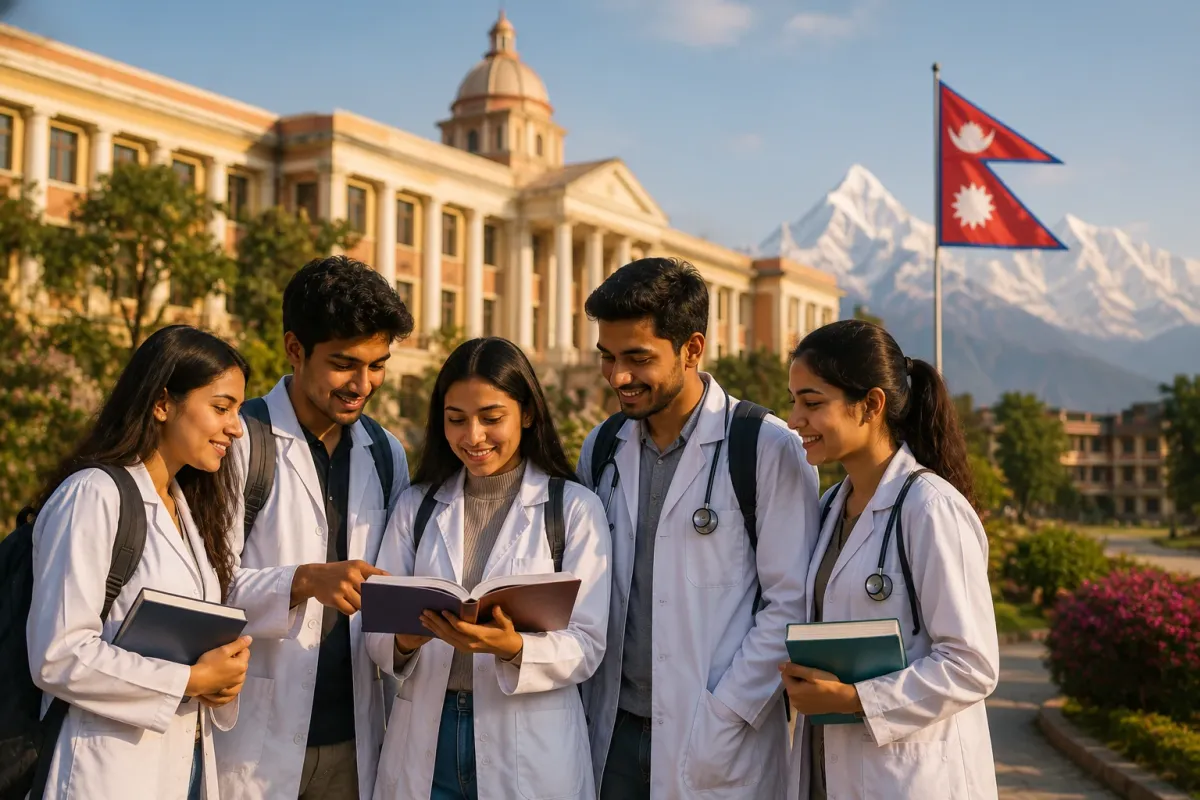
Every year, hundreds of Nepali students pursue medicine in India and for good reason. The country is close, the degrees are accepted by the Nepal Medical Council, and government college tuition runs a fraction of what you'd pay in the UK or Australia.
This guide covers everything that actually matters: eligibility and the NEET requirement, how the admission process works step by step, what things cost in both INR and NPR, how to verify a college's recognition status before you pay anything, and where Nepali students consistently go wrong. The goal is to give you the full picture and not just the parts that look good in a brochure.
Eligibility: What You Need Before You Even Think About NEET
Before the application process begins, you need to meet the baseline eligibility requirements. These are set by the Medical Counselling Committee (MCC) and are non-negotiable.
- Age: Minimum 17 years old by December 31st of the year of admission
- Subjects: 10+2 with Physics, Chemistry, Biology (PCB), and English
- Marks: Minimum 50% aggregate in PCB for the general category; 40% for certain reserved categories
- Entrance exam: NEET (UG) qualifying score — mandatory for all applicants, including foreign nationals
Your NEB +2 is recognized as equivalent to Indian Class 12 by the AIU Equivalence Division, which means Nepali students don't face the equivalency delays that students from many other countries face.
NEET: What It Actually Tests and Why the Score Matters Beyond Qualifying
Once your eligibility is confirmed, NEET is the central hurdle. There are no exemptions for foreign applicants. Nepali students sit the same exam as the 1.5+ million Indian candidates, based on the NCERT curriculum for Classes 11 and 12, covering Physics, Chemistry, Botany, and Zoology.
This is where Nepal-board preparation frequently falls short. The NEB curriculum and the NCERT pattern diverge enough that students who don't specifically prepare for NEET-style questions, particularly in Biology, often underperform. Most successful Nepali applicants treat NEET as a year-long commitment rather than a last-minute effort, with the final months focused heavily on NCERT Biology and consistent Physics practice.
Indian institutions can accept foreign students in up to 15% of seats beyond their sanctioned intake capacity, but those spots are competitive. A marginal qualifying rank won't secure a seat even at a private college's management quota. The higher your score, the more options you have, and the more leverage you have on fees.
With that in mind, here's how the admission process actually unfolds once your NEET result is in hand.
The Admission Process: Step by Step
Given below is the step-by-step process for the admission journey. Delays almost always occur in the document stage, not the exam stage, so preparing paperwork early is what separates students who make the July intake from those who wait another year.
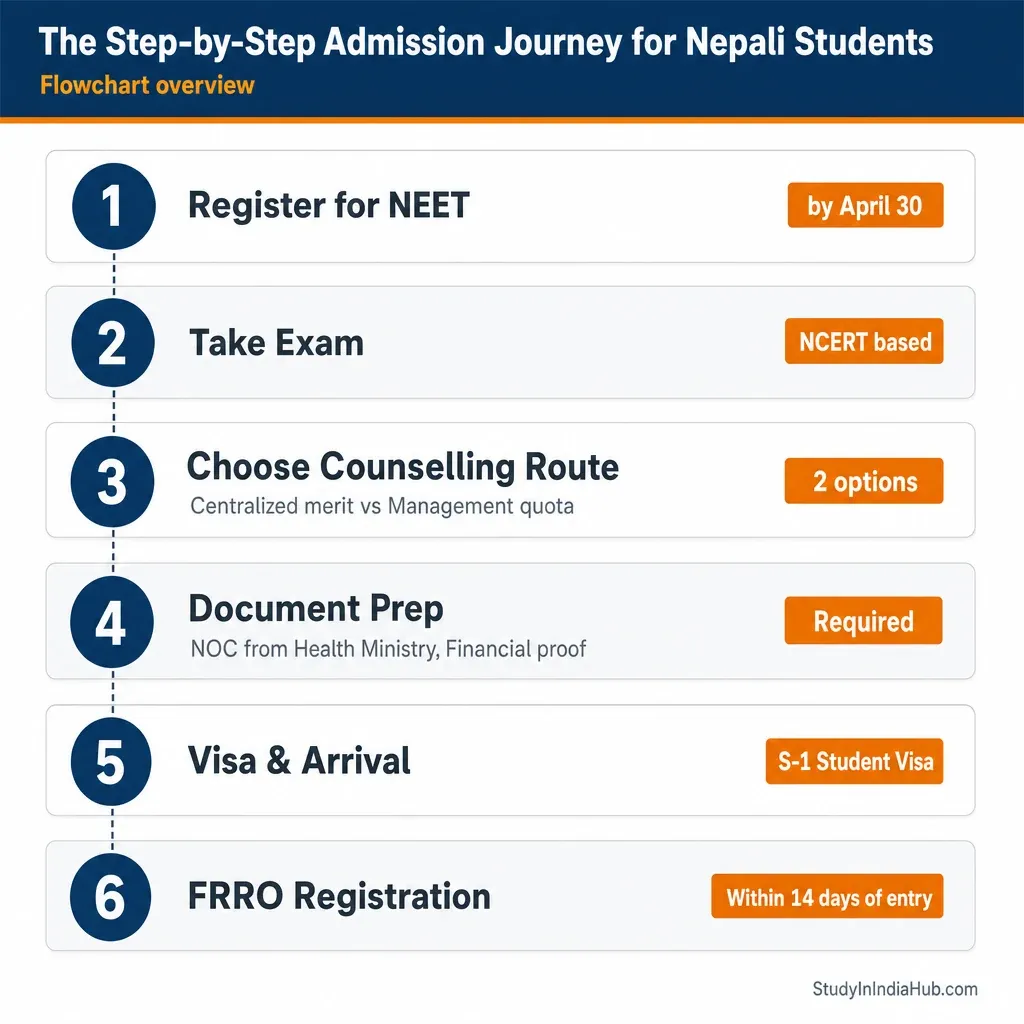
Step 1: Register for NEET
Register on the National Testing Agency (NTA) website as an international applicant. For the 2026–27 cycle, the deadline was 11 March 2026. The exam date and format are identical for Indian and international applicants.
Step 2: Choose Your Counselling Route
Two main pathways exist after your score is released:
| Route | Authority/Channel | Typical Timeline |
|---|---|---|
| Centralized counselling | DGHS (government colleges), merit-based | 2–3 months |
| Management quota / direct | Private colleges & deemed universities | 3–4 weeks |
Review the college notice, the counselling portal, and the seat category rules simultaneously; they can and do differ.
Step 3: Prepare Your Documents Before the Seat Is Confirmed
- NOC from the Ministry of Health (required for all medical programmes)
- Proof of enrollment in a full-time programme at an accredited institution
- Financial documentation: bank statements and sponsorship letters
- NEB +2 marksheets and certificates
- AIU equivalency certificate (apply early as this takes 5–11 business days normally, longer in June–July)
Step 4: Confirm your seat
Once you confirm admission, the college issues your final admission confirmation, fee receipt, and hostel information. End-to-end, a well-organized application takes 4–6 months. Add 1–2 months if you're going through centralized counselling.
Step 5: Visa and FRRO
As a Nepali national, the Treaty of Peace and Friendship allows you to enter India with just a passport and no formal student visa process required. However, if your stay exceeds 180 days, FRRO registration is mandatory within 14 days of arrival. Registration is done online at indianfrro.gov.in/eservices.
Fees Structure and Total Cost (in NPR and INR)
When calculating costs, the figure on the university website is rarely what you'll pay. Your total cost breaks into three categories: tuition, hostel and mess, and monthly living expenses. Each varies significantly by institution type and city.
Tuition: Government vs. Private
Government and central universities charge approximately INR 2–5 lakh per year for medical programmes. Over the full 5.5-year MBBS (4.5 years of study plus a one-year internship), total tuition comes to roughly INR 10–25 lakh.
Private colleges are a different story entirely. Total MBBS costs at private institutions range from INR 50 lakh to INR 1.5 crore, excluding accommodation, five to fifteen times the government rate. If you're eligible for SAARC quota seats at central universities, that concession is built into your admission fee category, not a separate application. Verify eligibility with each institution directly; don't assume the standard international rate applies to you.
| Expense | INR | NPR (approx.) |
|---|---|---|
| Govt tuition (total) | 10–25 lakh | 16–40 lakh |
| Private tuition (total) | 50 lakh–1.5 crore | 80 lakh–2.4 crore |
Hostel and Mess
On-campus housing is almost always the more financially stable option. Annual hostel and mess fees typically come up to INR 40,000–2,50,000 depending on the institution and room type.
Monthly Living Costs by City
Where your college is located can shift annual living expenses by 30–50%. Here's what a realistic month looks like across major medical education cities:
| City | Budget | Moderate | Comfortable |
|---|---|---|---|
| Pune | ₹12,000 | ₹20,000 | ₹32,000 |
| Delhi | ₹14,000 | ₹23,000 | ₹38,000 |
| Bangalore | ₹15,000 | ₹25,000 | ₹42,000 |
| Mumbai | ₹15,000 | ₹25,000 | ₹40,000 |
Apart from this, also plan for costs that don't appear on university websites: lab coats and instruments (INR 5,000–10,000), exam fees (INR 2,000–5,000 per semester), hospital rotation fees (INR 10,000–20,000), and Medical Council registration (INR 5,000). From working through budgets with over 200 students, every single one underestimated miscellaneous costs by 15–20%. Build that buffer in from the start.
Scholarships: How to Bring the Cost Down
MBBS is an expensive course and understanding the cost is one thing; reducing it is another. Nepali students have three main scholarship options that can help them reduce the overall cost significantly.
ICCR A2A Scholarship is the most valuable. The Indian Council for Cultural Relations offers fully funded scholarships covering tuition and living costs at central and state universities. Successful applicants receive a monthly living allowance, with total support typically exceeding ₹1.2–1.5 lakh per year depending on the level of study.
Approximately 4,000 applicants competed for around 200 fully funded scholarships in 2026–27, an acceptance rate of roughly 5–8%.
Two additional programs are managed by the Indian Embassy in Kathmandu; check the current slot availability in the Education Wing section prior to applying:
| Scheme | Slots (approx.) | Who it's for |
|---|---|---|
| Atal Bihari Vajpayee General Scholarship | 630 (indembkathmandu.gov.in) | General UG/PG, merit-based |
| Sushma Swaraj Silver Jubilee | 100 (indembkathmandu.gov.in) | Meritorious Nepali students |
| SAARC Scholarships | Varies (indoglobal.com.np) | SAARC-nation applicants |
Scholarships can be stacked in some cases: one student combined an ICCR award (covering tuition) with a university merit scholarship (covering hostel costs) to fund 90% of his MBBS fees. The key is getting the stacking policy confirmed in writing before you commit to an institution, as some colleges cap total aid.
Recognition of the Indian MBBS Degree in Nepal
Everything above, the NEET preparation, the scholarship applications, and the fees is only worthwhile if your degree is recognized when you return to Nepal. This is where the most serious mistakes happen, and they are almost entirely avoidable.
| Factor | Requirement |
|---|---|
| Where you study | College must be recognized by the National Medical Commission (India) |
| Where you practice | Must pass the Nepal Medical Council (NLE) to get a license in Nepal |
| Clinical standard | Strong infrastructure, experienced faculty, high patient inflow |
If your college does not hold current NMC recognition in India, you cannot sit the NLE in Nepal. An affordable seat at an unrecognized college is not a deal, it's a five-year investment with no return. To avoid future complications, there are simple ways in which you can verify.
How to verify :
- Check the NMC India portal for the college's current recognition status. Brochure claims are not sufficient.
- Confirm with the Nepal Medical Council directly at nmc.org.np and call or email for written confirmation. A comprehensive searchable list is not available in one place; you have to check the specific institution.
- Verify clinical capacity. The attached teaching hospital should have high patient inflow. Without it, your clinical skills won't meet NLE standards, MBBS without real patient exposure is inadequate preparation.
- Recheck recognition status again as your exam-eligibility date approaches. Lists are updated regularly; a college that was recognised when you enrolled may have had its status lapse.
Conclusion
MBBS in India is a genuinely viable path for Nepali students, but the outcomes vary enormously depending on which college you choose and how well you prepare the application. The students who navigate it well share a few things in common: they verify NMC recognition before they look at fees, they treat NEET preparation as a year-long commitment rather than a sprint, they apply for ICCR scholarships regardless of how competitive the odds seem, and they build a budget that includes everything.
Related guides
- MBBS in India for International Students: Fees, Eligibility, Top Colleges (2026)
- MBBS in India for Sri Lankan Students: Fees, Recognition & NEET Guide
- Study in India for Nepali Students: Complete Guide 2027
- Study in India for Students from UAE & Kuwait: Complete Guide for NRIs 2027
- Engineering in India for Nepali Students: Colleges, Fees in NPR, and Admission 2026