MBBS in India for Sri Lankan Students: Fees, Recognition & NEET Guide
India is one of the best destinations for Sri Lankan students who wants to pursue MBBS. Here's the real timeline, fees in INR and LKR, and why the exam you take after coming home matters more than the one that gets you in.
Every Sri Lankan student considering MBBS in India starts with the same question: what will it cost? Almost no one starts with the question that actually decides whether the degree means anything; what happens when you go back home. The fees, however large, is the part you can plan for. The ERPM, the exam the Sri Lanka Medical Council requires before you can practice in Colombo or Kandy, is the part that decides whether those 5.5 years in India turn into a career or a very expensive pause.
That's the gap this guide is built around: not just what NEET and tuition look like, but the full arc from application to licensure, because that's the arc that actually matters.
How India Stacks Up Against the Alternatives
When Sri Lankan students decide their destination for MBBS, India usually isn't the cheapest option on the table, but it's rarely the most expensive either, and it wins clearly on two things: recognition and travel time.
| Factor | India | Bangladesh | Pakistan | Philippines |
|---|---|---|---|---|
| Tuition (full course, approx.) | USD 30,000–60,000 | USD 30,000–45,000 | USD 25,000–40,000 | USD 20,000–35,000 |
| Course duration | 5.5 years (incl. internship) | 5 years + 1 year internship | 5 years + 1 year house job | MD: ~5–6 years (incl. pre-med) |
| Recognition (NMC/WHO listing) | Yes | Yes | Yes | Yes |
| Returning to Sri Lanka (ERPM/SLMC) | Must pass ERPM exam | Must pass ERPM exam | Must pass ERPM exam | Must pass ERPM exam |
| Travel from Sri Lanka | 1–4 hrs (very accessible) | 1.5–2 hrs | 4–5 hrs | 4–5 hrs |
| Medium of instruction | English | English | English | English |
In every one of these countries, you come home and sit the same ERPM exam. So the real differentiator isn't the destination, it's how well you prepare for that exam, regardless of where you studied.
For now, let's start where every application actually starts: NEET.
Eligibility and NEET Requirements
Since 2018, every international student needs a NEET score to get into an Indian medical college. No exceptions, no private-college workarounds. I've had students ask if a particular university "doesn't require NEET" and my answer: they all do, by law.
To even sit the exam, you need to meet a few baseline requirements first:
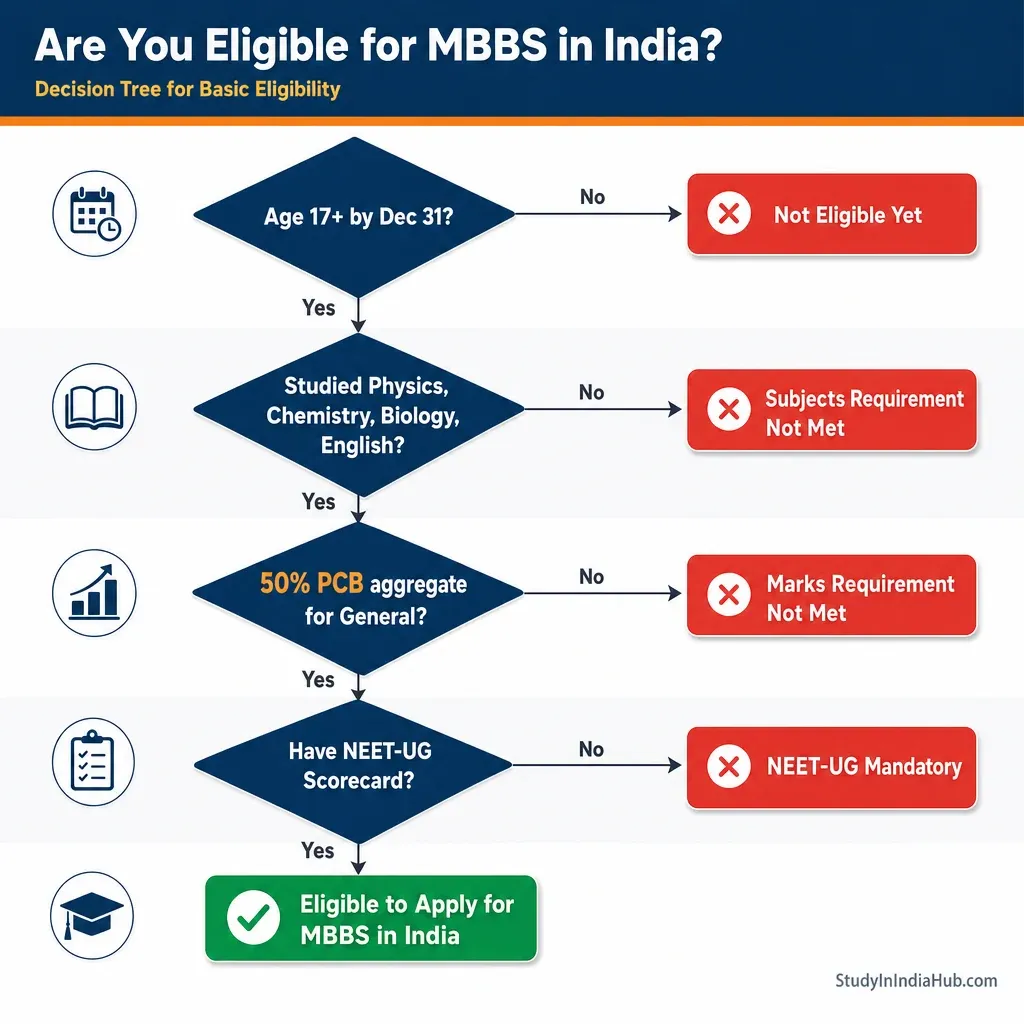
The official cutoff is 50% in PCB for the general category, but here's what every student should know: that number is the floor, not a target. Reputable colleges are realistically looking at 60–70%+. I've seen students with exactly 50% get rejected from their first-choice college, not because they failed any rule, but because better-qualified applicants simply filled the seats first. The 40% reserved-category threshold rarely applies to foreign nationals unless a university has specifically carved out seats for that purpose.
Steps to register for NEET
- Register online at neet.nta.nic.in. The window typically runs December to February for a May exam.
- Select "Non-Citizen" as your category and use your passport number as ID.
- The exam is offered in English, Hindi, and several regional languages, so choose English at registration.
- Registration closes 4–6 weeks before the exam date.
Many reputable private colleges have historically admitted international students with scores in the 400–550 range out of 720. However, this varies by college and year, so check the previous year's cutoffs for your specific shortlist. If a college doesn't publish international cutoffs, email admissions and ask them directly.
International students are admitted in addition to a college's regular intake, up to 15% extra. At SPPU, for instance, which already has over 14,000 international students, you're competing against other foreign applicants for that 15%, not against the full domestic merit list. If the ICCR scholarship is part of your plan, then ensure that your NEET score is in hand well before the scholarship window opens.
Once your NEET score is sorted, the next question is the one every student actually wants answered: what is this going to cost?
MBBS Fees for Sri Lankan Students (in LKR and INR)
For MBBS in India, the real cost breaks into three parts: tuition, hostel, and monthly living, and each varies a lot depending on the type of college.
Tuition by College Type
Government and central universities charge international students under a "foreign national quota" rate, which sits well below private college fees, typically USD 5,000–15,000 per year. I've seen this play out very differently for two students in the same intake year: one from Colombo paid INR 3,50,000/year at a central university, while another paid INR 7,50,000/year at a state university in Maharashtra. Same NEET score range, very different costs, and the difference came down to the college's fee category, not merit.
| College type | Annual tuition (INR) | In LKR | Notes |
|---|---|---|---|
| Government | INR 3,50,000–7,50,000 | LKR 11–24 Lakhs | Best value under foreign national quota; seats limited, fees vary by category (Study in India) |
| Deemed | INR 8,00,000–18,00,000 | LKR 25–58 Lakhs | Mid-range; hostel and mess push first-year cost higher (Chanakya University) |
| Private | INR 15,00,000–30,00,000 | LKR 48–96 Lakhs | Where budgets break, especially metro colleges (Study in India) |
Hostel and Living Costs
Hostel fees and the living cost of a city are two most important cost factors. Most universities charge ₹1,000–3,000/month, or ₹40,000–2,50,000/year (roughly LKR 1.28–8 lakh), for hostel and mess combined.
City choice is what layers next. Here's what monthly living looks like across the cities where Sri Lankan students most commonly end up:
| City | Budget (INR/LKR) | Moderate (INR/LKR) | Comfortable (INR/LKR) |
|---|---|---|---|
| Pune | ₹12,000 / ~48,500 | ₹20,000 / ~80,000 | ₹32,000 / ~1.28L |
| Delhi | ₹14,000 / ~56,500 | ₹23,000 / ~93,000 | ₹38,000 / ~1.53L |
| Bangalore | ₹15,000 / ~60,500 | ₹25,000 / ~1.01L | ₹42,000 / ~1.70L |
| Mumbai | ₹15,000 / ~60,500 | ₹25,000 / ~1.01L | ₹40,000 / ~1.62L |
What 5.5 Years Actually Adds Up To
MBBS is a 5.5 year course so let's put real numbers against a government-college route, because seeing it as a single total changes how students plan:
- Tuition: ₹3,50,000/year × 5.5 = ₹19,25,000 (LKR 61.6 lakh)
- Hostel: ₹1,50,000/year × 5.5 = ₹8,25,000 (LKR 26.4 lakh)
- Living (moderate): ₹20,000/month × 66 months = ₹13,20,000 (LKR 42.2 lakh)
- Books, labs, exams: approximately ₹2,00,000 (LKR 6.4 lakh)
- Total: ₹43,70,000 — roughly LKR 1.40 crore, or about USD 53,000
For comparison, a student at a private college over the same period is realistically looking at ₹1 crore or more (LKR 3.2 crore+).
Degree Recognition and the Sri Lanka Medical Council
Now that we have discussed NEET and costs, let us read about what that degree actually matters for a Sri Lankan student. An Indian MBBS does not, by itself, let you practice medicine in Sri Lanka. The degree gets you most of the way there, but the actual license comes from a separate process entirely, which is the Examination for Registration to Practice Medicine (ERPM), sometimes still called Act 16, administered by the Sri Lanka Medical Council.
To simplify, your Indian MBBS must come from a college recognized by India's National Medical Commission (NMC). The SLMC only accepts degrees from NMC-recognized institutions, so if your college isn't on that list, you can't even sit the ERPM. After graduation, you register with the SLMC, submit your degree and transcripts, and then sit the ERPM, which is split into Part A and Part B. Students who prepare for both sections together tend to clear it faster than those who treat them separately.
Students mostly find the ERPM as the real obstacle and not the MBBS itself. It's common to need two or three attempts across both parts, and the gap between finishing your degree and getting full registration often stretches to 12–18 months. The ERPM tests your ability to apply your medical knowledge against Sri Lanka's clinical case patterns and public health priorities, which differ from what you'll have seen during your Indian rotations.
This is also why your choice of college matters more than it might seem at the application stage. Before you pay any seat-booking fee, work through this checklist:
- Confirm NMC recognition: Check the National Medical Commission's list directly, not the college's claim about itself.
- Confirm SLMC acceptance: Call or email the SLMC, name the specific institution, and get written confirmation that they accept MBBS degrees from it.
- Confirm the college actually takes international/NRI applicants: Some colleges don't, regardless of what a broker tells you.
- Keep every admission and fee document from day one: Inconsistent paperwork is one of the most common causes of registration delays later.
- Budget for the ERPM separately: It's a post-graduation cost, and it's not included in any tuition figure you'll see.
Once you're through to graduation and registration, build in a 15–20% buffer specifically for the return-and-exam period, which also includes travel, accommodation while preparing, and the exam fees themselves. Families who allocate their entire budget to tuition and treat the post-graduation phase as an afterthought are the ones who end up financially stretched right when they're closest to the finish line.
The Application Process, Step by Step
The order here while filling out the application matters. If you miss a deadline at one stage, it can lock you out of the next one entirely, even if you're otherwise qualified.
Step 1: Sit NEET first
Register via the NTA website using your passport number and an active email. Once your score is out, you can proceed immediately as most colleges accept the NTA portal scorecard without waiting for a formal printed certificate.
Step 2: Pick the right portal for your route
July–August intakes can see processing stretch to 6–8 weeks due to volume, so apply early.
Step 3: Submit the application with complete documents
Delays at this stage are rarely about a student's qualifications; they're about a missing scan or an unverified form. Get your NEET result card, 12th-grade transcripts (with equivalency confirmation if required), passport copy, and proof of Sri Lankan residency with a purpose statement ready. Submit everything together, save your acknowledgment receipt, and build in an extra week for any follow-up document requests.
Step 4: Wait for seat allocation, then act fast
Merit lists typically come out 2–4 weeks after the application deadline. If you're offered a seat, you'll usually have a 3–5 day window to accept. For direct-admission routes, expect an institutional fee around USD 5,400/year, with an additional USD 600/year NCHMCT fee where applicable.
Step 5: Pay and confirm
If you're a scholarship recipient, check first whether the scholarship body pays the college directly- don't transfer funds yourself before confirming this. Once payment clears, you'll receive your enrolment confirmation.
With your seat locked in, the next thing on your plate is the visa, and the good news is that for Sri Lankan applicants, this part is more straightforward than people expect.
Visa, Travel, and Your First Two Weeks
The S-1 student visa process for Sri Lankan applicants is entirely document-based. Your application goes through the Indian High Commission in Colombo, and approval comes down to how complete your file is.
What you'll need
- Completed visa application form (via Indian Visa Online)
- Acceptance letter from your Indian college as without this, nothing else proceeds
- Academic records, including original G.C.E. A/L certificates and transcripts
- Financial documentation: bank statements, sponsor letters, or scholarship confirmation covering tuition and living costs
- Passport valid for at least 6 months beyond your travel date
- Proof of accommodation, hostel confirmation or a lease
The processing typically takes 5–7 business days, occasionally stretching to 10 if anything needs clarification. Visa and VFS fees vary by mission, so check current rates before paying. For a full-length degree, the visa is generally valid for up to 5 years or your course duration, whichever is shorter.
Summing Up
To sum up, let's understand a real-case scenario. After clearing NEET, the student secured an MBBS seat at a recognized university in Tamil Nadu. Across the full 5.5-year programme, including tuition, hostel, and living costs combined, the total came to roughly ₹65–75 lakh. The course ran its normal course, followed by the mandatory six-month rotational internship.
After returning to Sri Lanka, the graduate registered with the SLMC and sat the ERPM. It took more than one attempt across both parts which, as I've mentioned, is genuinely common, but clearing it brought full registration to practice.
So its safe to say that india remains one of the most practical routes into medicine for Sri Lankan students: close, English-medium, and a fraction of what Western alternatives demand upfront. The degree works. The license is what takes planning and that planning starts on day one, not in year six.
Related guides
- MBBS in India for International Students: Fees, Eligibility, Top Colleges (2026)
- Study in India for Sri Lankan Students: Admissions, Fees & Visa (2027)
- MBBS in India for Nepali Students: NEET, Fees & Recognition in Nepal
- How Much Does It Cost to Study in India for International Students? (2026 Breakdown)
- MBA in India for International Students: Best Colleges, Fees & ROI (2026)