India vs Canada vs Australia: Where Should International Students Study? (2026)
India, Canada, or Australia- which country is right for international students in 2026? Compare tuition, living costs, visa approval rates, post-study work rights, and PR pathways to find the best fit.

Choosing where to study abroad today is a stressful decision that requires thorough research. Today, a Canadian study permit that would have sailed through in 2022 gets rejected in 2026. Australia quietly raised its proof-of-funds threshold mid-year. India, meanwhile, now hosts campuses from universities in Southampton, Deakin, and Wollongong, which means you can earn a Western degree without paying Western prices.
This guide is built around one question: not where is it nice to study, but where does studying actually take you: financially, professionally, and in terms of where you can live afterwards.
The Real Cost of Studying in Each Country
When calculating the total cost, tuition is the number that gets advertised. In Canada and Australia, tuition accounts for less than 60% of what students actually spend over four years. The rest goes to rent, health insurance, visa fees, flights home, and a dozen smaller expenses that add up faster than expected.
Here's how the numbers compare across five major study destinations:
| Country | Tuition/Year | Living/Month | 4-Year Tuition | 4-Year Living | 4-Year Total |
|---|---|---|---|---|---|
| Germany | €300 | €1,000 | €1,200 | €48,000 | ~$14,000 USD |
| India | $1,500 | $300 | $6,000 | $14,400 | ~$20,400 USD |
| Canada | CAD $20,000 | CAD $1,200 | CAD $80,000 | CAD $57,600 | ~$100,000 USD |
| Australia | AUD $24,000 | AUD $1,400 | AUD $96,000 | AUD $67,200 | ~$107,000 USD |
| UK | £22,000 | £1,300 | £88,000 | £62,400 | ~$120,000 USD |
Sources: DAAD, Study in India, Statistics Canada, Study Australia, UCAS, Numbeo UK.
India's four-year cost comes in at roughly one-quarter to one-fifth of what you'd spend in Canada or Australia. For instance, a B.Tech at VIT, costs between $3,000 and $5,000 per year in tuition. The equivalent program in Toronto or Melbourne runs four to five times that before factoring in living expenses.
In Canada, visa officers now verify that applicants have CAD $20,635 in liquid funds — a threshold that more than doubled in 2024. In Australia, the minimum proof-of-funds requirement rose to AUD $29,710 in May 2024, with an additional AUD $2,000 per dependent from 2025. Currency fluctuations alone can shift that figure by 5–10% in a single month.
The hidden costs nobody talks about
Three students we tracked over 2022–26: one at IIT Bombay, one at the University of Toronto, one at the University of Melbourne, ended up spending roughly ₹12.8 lakh, CAD $238,000, and AUD $312,000 respectively over four years. The surprises were consistent: health insurance (CAD $900/year in Ontario; AUD $2,600/year in Victoria), winter clothing (over CAD $1,200 in the first Toronto winter), visa renewals and return flights in Years 2 and 3, and at IIT Bombay, dining, lab materials, and relocation for internships totalling around ₹1.8 lakh across four years.
So budget at least 15–20% above the university's published cost-of-attendance for any overseas destination. For India, that buffer is smaller, but still worth building in.
Visa Process and How Hard It Is to Get In
The visa process is where many applications quietly fall apart, not because of grades or finances, but because of missing documents, missed deadlines, or policy changes. The three countries operate very differently here.
| Factor | India | Canada | Australia |
|---|---|---|---|
| Interview required | No — document-based | Possible | Possible |
| Approval rate (2025) | Straightforward | ~44% (Indian applicants) | Selective; financials-heavy |
| 2026 policy risk | Stable | Permit cap continues | Financial threshold rising |
| Post-study work | Not permitted | Up to 3 years (PGWP) | 2–4 years (Subclass 485) |
| Financial proof required | Full program duration | CAD $20,635 | AUD $29,710 |
India
The Indian student visa (S-1) is the most straightforward of the three. There's no interview and it's entirely document-based. Processing takes 7–14 business days when the paperwork is complete. The two most common rejection reasons aren't complicated: incomplete acceptance letters and inadequate financial documentation.
Canada
Canada's study permit landscape shifted significantly in 2024. Their overall acceptance rate dropped from around 60% in 2023 to approximately 38% in 2024. For Indian applicants specifically, approvals fell to around 44%. The federal cap of 437,000 permits for 2025 — and a projected 155,000 approvals for 2026 — means that even a strong application from a designated learning institution is no longer a sure thing.
Apply at least five months before your intended intake. Applicants with guaranteed university funding consistently perform better. Those without strong financial documentation are increasingly being turned away.
Australia
Australia's visa process sits between India and Canada in terms of difficulty. The median processing time is 33 days. Financial requirements rose to AUD $29,710 in May 2024 and are expected to keep increasing. English language benchmarks also shifted in January 2026, and the required level for several visa categories moved to B2.
The upside: Australian student visas include post-study work rights, and on-campus employment is permitted while enrolled.
Education Quality: What You're Actually Getting
The most important criterion when making a decision is the education quality. India has the second-largest higher education system in the world. Over 1,400 universities and 52,000 colleges serve around 20 million students as of 2026. When talking about the quality, an IIT or a top government medical school offers a world-class, heavily subsidised education. Whereas a weaker private institution might charge ten times more while delivering significantly less.
QS 2025 rankings place IIT Bombay at #118 globally. NIRF 2024 ranks it #3 for engineering and #4 overall nationally. But rankings are a starting point, not a verdict. A well-funded department with strong industry links — even at a mid-tier university can outperform a higher-ranked institution with poor teaching quality.
India's National Education Policy 2020 now allows international universities ranked in the global top 500 to establish campuses in India. The University of Southampton's Gurugram campus is already operational. Deakin University, the University of Wollongong, and the University of Western Australia have received approval for GIFT City campuses. It's now possible to earn an Australian degree while staying in India, at a significantly lower cost.
| Feature | India | Canada | Australia |
|---|---|---|---|
| Primary Strength | STEM & medicine affordability | Co-op & applied learning | Research & innovation |
| System Size | 20M capacity | Mid-sized, public-heavy | Small, high-ranking |
| Cost Advantage | Up to ¼ the cost of Western options | Moderate | High tuition |
| Research Profile | Emerging, IIT-led | Established global standing | Group of Eight universities |
Life After Graduation: Jobs, Visas, and the Road to PR
The post-graduation landscape is where the three countries diverge most sharply, and where the decision often looks different in hindsight. When you are choosing the country to study, always do your research around their post graduation scenes. Is it really worth it?
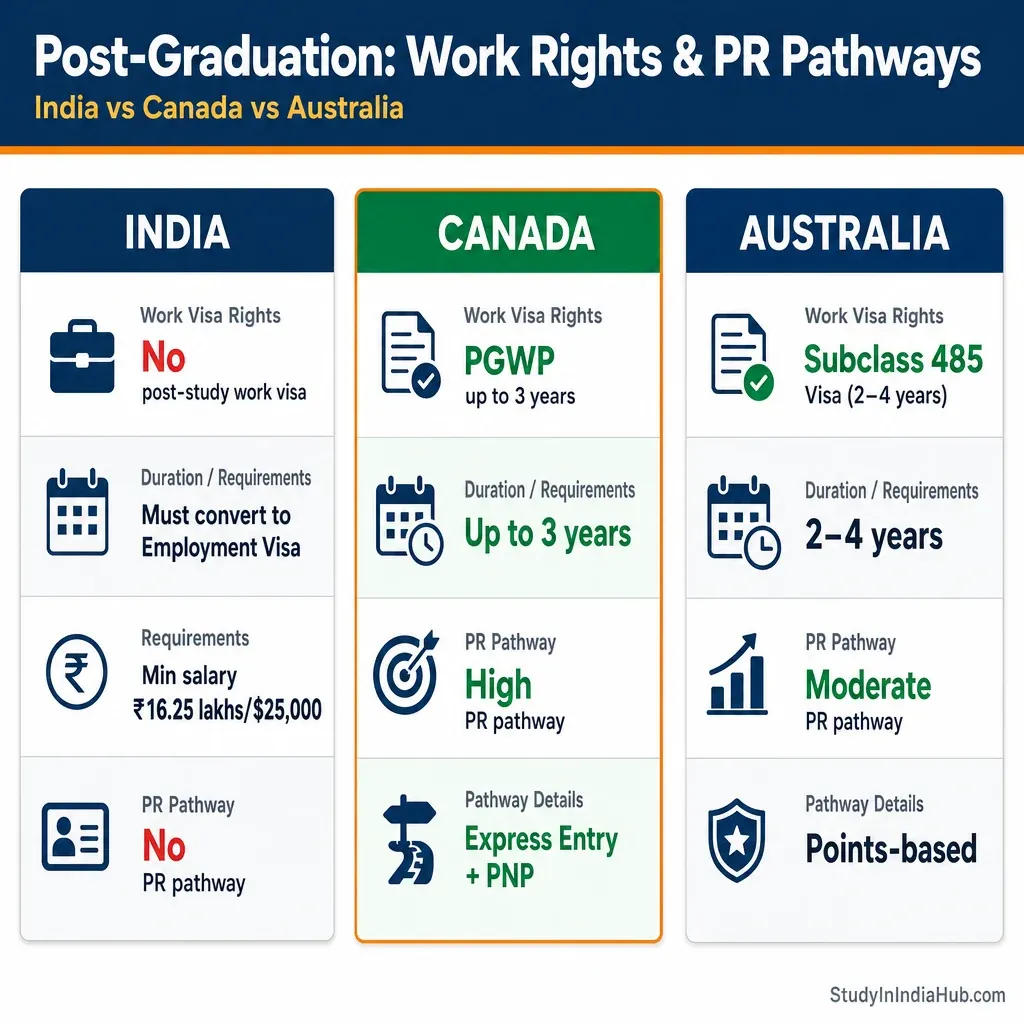
India
India's placement numbers are quite impressive and currently at the top of the pyramid. At IIMs and ISB, placement rates approach 100% within three months of graduation, most years without exception. The broader picture is more mixed: across all institutions, roughly 82% of students secured jobs in the 2022–23 placement cycle.
The concerning point is what happens next. To stay in India on an Employment Visa after your Student Visa expires, your annual salary must exceed ₹16.25 lakh (approximately $25,000). Graduates from elite programs comfortably clear that bar, but those from mid-tier institutions often don't. As of now, there is no structured pathway to permanent residency for international graduates, regardless of employment.
Canada
Currently, Canada offers the most clearly mapped immigration pathway out of the three. The Post-Graduation Work Permit (PGWP) is valid for up to three years and directly feeds into the Express Entry system, adding points toward permanent residency. Combined with provincial nomination programs (PNPs), the route from student to permanent resident is well-documented and achievable.
Australia
Australia's Subclass 485 Temporary Graduate Visa gives graduates two to four years of work rights, depending on qualification level and where they studied. Regional graduates receive additional points in the PR system, which has made universities outside Sydney and Melbourne increasingly attractive.
That said, the job market for skilled roles is competitive. Graduates report spending six to twelve months in transitional work before landing roles in their target industry.
Which Country Fits Which Student
There is no 'one size fits all' approach when choosing the right country for your education. There are various factors that need to be thought of before jumping to a conclusion.
Choose India if cost is your primary constraint. India's cost advantage is real and significant. If you stack ICCR scholarships with DASA allocations and merit-based waivers, you can cover 80–90% of expenses at a Symbiosis or NIT program. The catch: you cannot work while studying, internships need university authorisation, and your family covers costs upfront with no part-time income to offset them.
Choose Canada or Australia if you plan to stay after graduation. If your plan is to stay abroad after your education, then Canada or Australia might be a better option. India has no structured post-study PR route for international graduates. Employer sponsorship is competitive and salary-gated. So, if long-term settlement is the goal, choosing India on the assumption that transitioning later will be easy is a mistake.
Choose India selectively if the program has strong brand recognition. An IIT or IIM degree carries weight across Asia, the Middle East, and increasingly in global tech hiring. The cost-to-outcome ratio is hard to match for students planning to return home or work regionally.
The Bottom Line
There is no universally correct answer.
India is the strongest choice if minimising cost is the primary objective and you're targeting a reputable institution. Canada is the strongest choice if permanent residency in a developed country is the five-year goal. Australia sits in a useful middle ground: more expensive than India, more flexible post-graduation, and competitive with Canada on work rights.
Whichever country you choose, verify all figures on official government websites before committing. Costs, quotas, and thresholds have all shifted in the past 12 months.
Related guides
- Cheapest Countries to Study Abroad: Global University Fee Comparison (2026)
- How Much Does It Cost to Study in India for International Students? (2026 Breakdown)
- Is India Cheaper Than UK/Canada for Students? (Real Cost Comparison 2026)
- Scholarships for International Students in India (2026 Complete List)
- India vs UK for International Students: Cost, Quality & ROI Compared (2026)
- Can International Students Work While Studying in India? (2026)