India vs UK for International Students: Cost, Quality & ROI Compared (2026)
Confused between studying in India or the UK? This 2026 article compares tuition fees, living costs, rankings, work visas, placements, and ROI for international students so you can choose the best destination based on your budget and career goals.

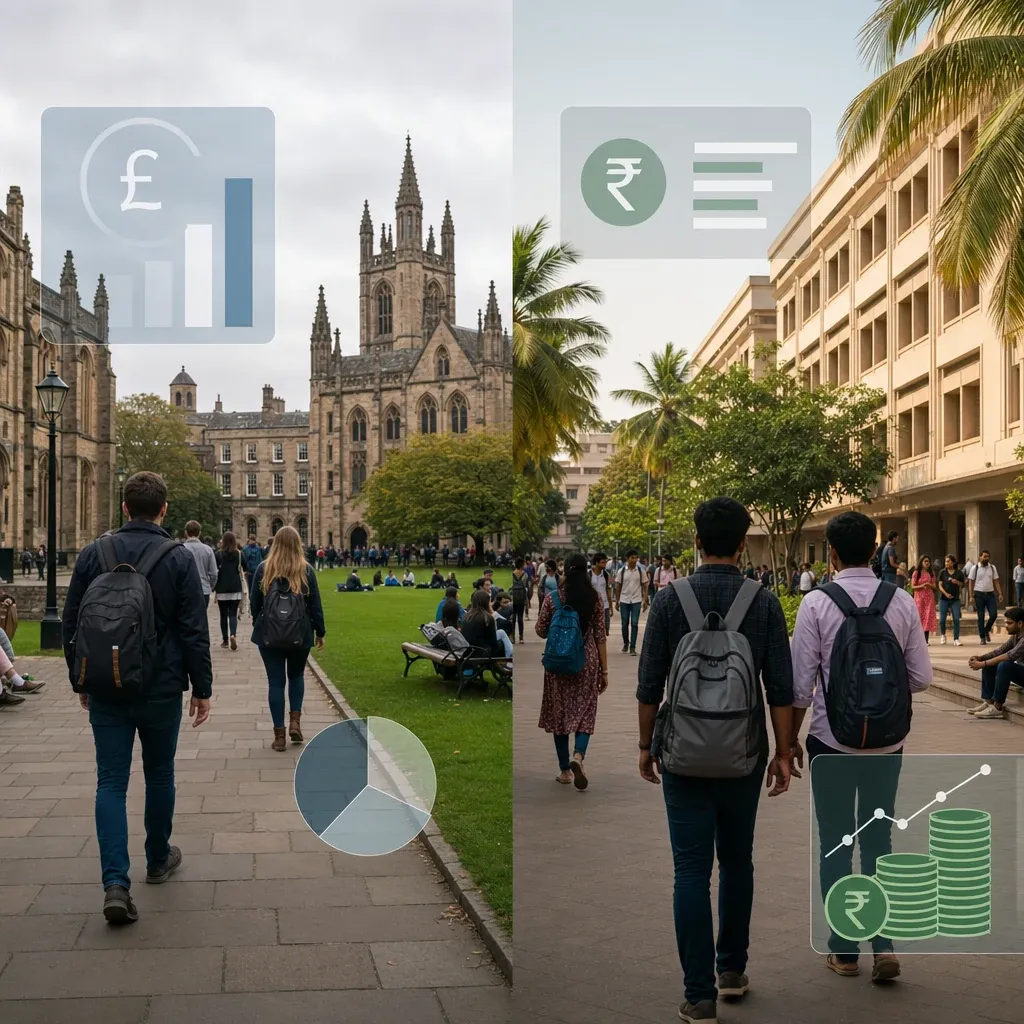
India and the UK represent two genuinely different bets on your education. The UK offers global brand recognition, a structured post-study work pathway, and direct access to Western job markets. Whereas, India offers programs at roughly one-quarter the cost, near-100% placement rates at top institutions, and a faster path to breaking even on your investment.
What matters here is where you want to work after graduation, how much debt you're willing to carry, and whether your target employers care more about the name on your degree or the skills behind it.
Total Cost Breakdown: What You'll Actually Spend
Most students compare by looking at tuition costs. That's a mistake — not because its not important, but because tuition is only one part of what you'll actually spend. The number that matters is tuition plus 12 months of living expenses plus visa costs. When you calculate it that way, the gap between the two countries becomes even wider than the tuition comparison suggests.
Combining those figures across a full two-year program shows just how much the gap compounds:
| Scenario | India (2 years) | UK (2 years) | India saving |
|---|---|---|---|
| Budget (mid-tier + modest living) | ₹9,00,000 (~£9,000) | ~£68,500 | ~87% cheaper |
| Mid-tier (e.g., Symbiosis MBA + city living) | ₹20,00,000 (~£20,000) | ~£92,000–£116,000 | ~78–83% cheaper |
| Top-tier India vs. mid-tier UK | ₹28,00,000–₹32,00,000 (~£28,000–£32,000) | ~£54,000–£84,000 | ~40–60% cheaper |
To put the living cost difference in perspective: UK living expenses alone over two years total £24,000–£48,000, before a single pound of tuition is paid. India's equivalent over the same period is ₹2,40,000–₹7,20,000 (~£2,300–£6,900).
Where the Gap Narrows
At the premium end of Indian education, the difference narrows but doesn't disappear. Leading programs at Symbiosis MBA, FLAME, elite tracks at Delhi University - run ₹6,00,000–₹16,00,000/year. A mid-range UK postgraduate course costs £15,000–£18,000/year in tuition alone. India is still affordable by 40–60% at this tier, but the total gap narrows from six-figure territory to roughly £20,000–£40,000 over the full program.
Costs Most Students Miss
Every budget has some blind spots. These are the line items that reliably don't appear on university fee pages but can cause issues later:
- Health insurance in India: ₹5,000–₹12,000/year — mandatory, rarely mentioned on tuition pages.
- UK Immigration Health Surcharge (IHS): Paid upfront as part of the visa application; amount depends on course length.
- Employment Visa threshold after Indian graduation: Minimum gross salary of ₹16.25 lakh/year (~$25,000) is required for sponsorship.
- Exam fees, course materials, return flights: Budget these separately as they can accumulate significantly across two years.
The rule: always evaluate tuition + 12 months of living costs + visa fees as one combined figure before comparing destinations.
Academic Quality and Rankings
Cost is half the equation. What you get for that cost is the other half, and this is where the comparison gets more nuanced than most rankings suggest.
It's a fact that the UK has more universities in the global top 100 across QS and Times Higher Education. But treating India and the UK as single comparable units is where students make expensive mistakes. A UK institution ranked 80–150 globally does not automatically outperform an IIT or IIM in your specific field or your target job market. Global rankings weigh research productivity and international faculty ratios heavily; some metrics that structurally favour UK institutions, regardless of what their graduates actually earn or how quickly they find jobs.
Placement data tells a more useful story. IIM Ahmedabad's 2024 Placement Report showed 100% of the graduating cohort receiving offers, with an average CTC of ₹34.36 LPA. ISB Hyderabad's Class of 2024 report recorded a median salary of ₹34.20 LPA with offers to the full cohort. Institutions affiliated with SPPU reported 85–92% placement rates for top engineering and management programs in 2024–25, with average packages of ₹6–8 LPA.
Outside the IITs and IIMs, domain depth matters more than national prestige. ISI Kolkata and Jadavpur University carry genuine international standing in statistics and engineering respectively. Neither appears in the global top 200, but employer recognition in their fields is real and well-established.
The table below summarizes where each country holds a genuine advantage:
| Quality Factor | India's Strength | UK's Strength |
|---|---|---|
| Elite Specialization | IITs (Engineering), IIMs/ISB (Management), ISI (Statistics) | Broad excellence — Oxbridge, Imperial, UCL |
| Graduate Employability | Near-100% placement at top IIMs/ISB within 3 months (collegesearch.in); strong placement cells | Strong global brand in finance, consulting, research |
| Research & Global Rank | Concentrated in a few elite institutes; fewer in global top 200 | More universities in top 100; higher average research output |
| Cost-to-Quality Ratio | Top-50 global MBA at an IIM: ₹15–25 lakh total | Comparable UK program: £25,000–45,000 per year |
One development worth watching: per NEP 2020, India now permits the top 100 global universities to establish campuses in India, which will gradually shift the competitive landscape. Verify institutional status before finalizing any decision.
Post-Study Work Rights
The sharpest practical difference between India and the UK education system is the post-study work rights. The two countries don't just have different rules; they have structurally different systems that reward different types of planning.
Before looking at the specifics, it's worth understanding what's at stake. Post-study work rights determine whether you can stay in the country after graduation to build experience, repay debt, and establish yourself professionally; or whether you need to secure employment sponsorship before your student visa expires. That distinction has a direct effect on your ROI, your stress levels in the final semester, and how much time pressure you're under when negotiating your first offer.
Here's how the two systems compare:
| Aspect | United Kingdom | India |
|---|---|---|
| During Study | 20 hrs/week in term time; full-time in holidays (UK Government) | No standardized hourly cap published in official sources |
| Post-Study Work | Graduate Route: 2 years (3 years for PhD); no job offer or sponsor required (UK Government) | No standard post-study work visa; must convert to Employment Visa with a sponsor (Bureau of Immigration) |
| Salary Threshold | None on Graduate Route | Minimum ~₹16.25 lakh/year (~USD $25,000) to qualify for Employment Visa (CGI San Francisco) |
The UK Graduate Route is the most significant post-study differentiator in this comparison. It provides 24 months (36 for PhDs) to work without sponsorship -time to switch roles, build UK experience, or transition to a Skilled Worker Visa without the pressure of a ticking clock on your student visa.
That said, the Graduate Route is the beginning of the process, not the end of it. Converting to a long-term Skilled Worker Visa is where many students hit difficulty. Mid-tier graduates outside London typically need roles paying at least £38,700. Employers also pay Certificate of Sponsorship fees plus an Immigration Skills Charge of £1,000/year for medium and large sponsors - a cost many smaller companies quietly avoid.
India's route works differently at every stage. The Employment Visa process is employer-initiated, not student-initiated, and the qualifying salary must be confirmed before your student visa expires. Even capable graduates face a tight window if they haven't lined up a sponsoring employer before their final semester. The employers most consistently willing to navigate the sponsorship process are the same ones making the largest offers - McKinsey, Goldman Sachs, Amazon, and similar multinationals.
ROI: Which Degree Pays Off Faster?
Return on investment is the question that cuts through everything else. At its core, it's a simple calculation: total spend divided by how long it takes your post-graduation salary to recover that cost. But the answer changes significantly depending on which market you're entering and whether you stay in it long enough for the salary trajectory to compound.
If your target employers are in India, Southeast Asia, or the Gulf, India has faster ROI and lower financial risk. If your target employers are in Europe or multinational firms paying in sterling or euros, the UK cost can be recovered, but only if you secure a market-rate offer and navigate the visa conversion successfully.
Which Country Should You Choose?
By this point, you have the costs, the quality picture, the post-study work rules, and the ROI scenarios. The question is how to apply them to your specific situation. The answer isn't the same for everyone, as it depends on your budget, the job market you're targeting, your home country's proximity to India or the UK, and how much value you place on a post-study immigration pathway.
The table below summarizes the clearest signals:
| Your Profile | Recommended Country | Primary Reason |
|---|---|---|
| Budget-Constrained | India | Tuition 60–80% lower; minimal debt possible |
| South/Southeast Asian | India | Faster visa processing, familiar documents, cultural proximity |
| Global Corporate Career | UK | Brand recognition in Western recruitment |
| Post-Study Immigration | UK | Established Graduate Route; unsponsored 2-year work permit |
The biggest mistake in this comparison is treating it as a binary quality question. It's a financial and career geography question. Run the numbers against your specific target market, factor in the realistic scholarship funding available to you, and base the decision on where your offer letter is most likely to come from and not where the ranking table puts either country.
Related guides
- Is India Cheaper Than UK/Canada for Students? (Real Cost Comparison 2026)
- How Much Does It Cost to Study in India for International Students? (2026 Breakdown)
- MBA in India for International Students: Best Colleges, Fees & ROI (2026)
- India vs Canada vs Australia: Where Should International Students Study? (2026)
- Cheapest Countries to Study Abroad: Global University Fee Comparison (2026)