Is India Cheaper Than UK/Canada for Students? (Real Cost Comparison 2026)
Choosing where to study is as much a financial decision as an academic one. This article compares the full cost of a 4-year degree course across India, the UK, Canada, Australia, and Germany. It includes tuition, rent, food, visa fees, and the hidden costs most students miss.

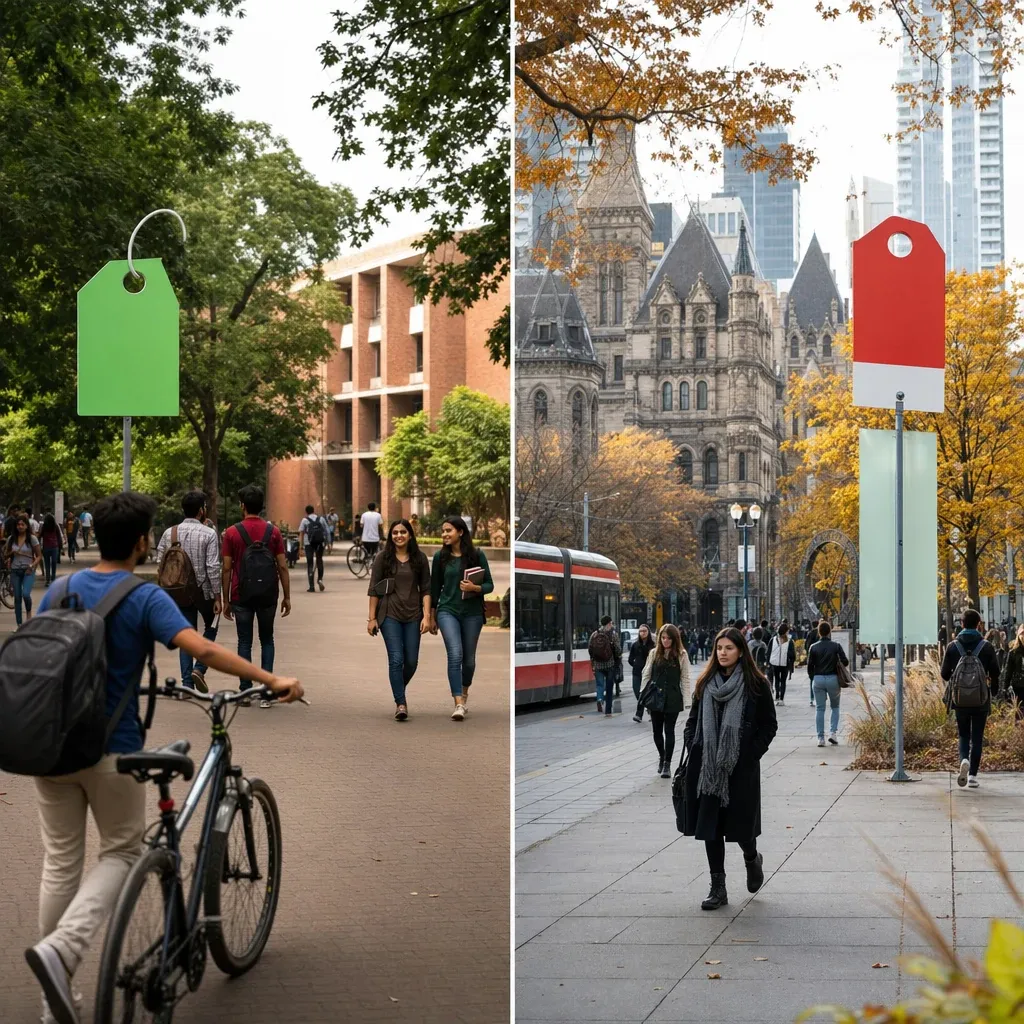
If India is affordable than other countries especially UK and Canada for students, is a pressing question that we come across. And the answer to that is yes; India is much less expensive. If you are weighing up India against the UK or Canada for a degree, the cost difference is not subtle it's enormous.
We're talking about a gap of $90,000 to $140,000 over four years, depending on where you go and what you study.
But just tuition numbers only tell part of the story. There's a lot more that needs to be considered. Whether you're a student from Nepal, Bangladesh, Sri Lanka, or anywhere else in the world, here's what you actually need to know before making this decision.
Let's Understand The Cost Breakdown
When compared to countries like UK or Canada, education in India is significantly affordable. Here's a quick overview of what a 4-year undergraduate degree actually costs, including tuition and living:
| Country | Annual Tuition | Monthly Living | 4-Year Total |
|---|---|---|---|
| India | ~$1,500 | ~$300 | ~$19,200 |
| UK | ~$22,000 | ~$1,300 | ~$132,400 |
| Canada | ~$41,746 per year | ~$3,478 | ~$166,980 |
Sources: UCAS, Statistics Canada
The cost gap between India and the UK is roughly $113,000 over four years. Between India and Canada, it's around $95,000. The bottom line here is that studying in India costs about a quarter of what you'd pay in the UK or Canada. There are two primary components you should evalaute when looking at costs: Tuition fees and Cost of Living.
Tuition Fees: What You Actually Pay Each Year
In India, international students typically pay between $1,500 and $5,000 per year for undergraduate programs, and up to $6,000 for postgraduate. Even India's top-tier institutions are priced lower than most budgeted options in the UK or Canada.
Note: India figures apply to private universities. State university fees are much lower than this.
Tuition Cost in India
The spread of universities within India is wide, and the institution matters as much as the country. So, here are some reference points for you to understand better:
- IIT Mumbai — Foreign B.Tech students pay approximately ₹3,23,350 per year. That's less than one quarter of UK tuition.
- VIT — International B.Tech tuition ranges from $3,000–$5,000 per year.
- Symbiosis International University — Master's programs are priced at ₹3,00,000–₹5,00,000 annually.
The tuition costs in India vary on various factors but ranging on the type of university and the type of course, you can get an overview about the range.
Living Costs: Rent, Food, and Transport by City
Apart from tuition fees, living costs are where India stands out. Monthly living costs in India's major student cities are a fraction of what you'd spend in London or Toronto.
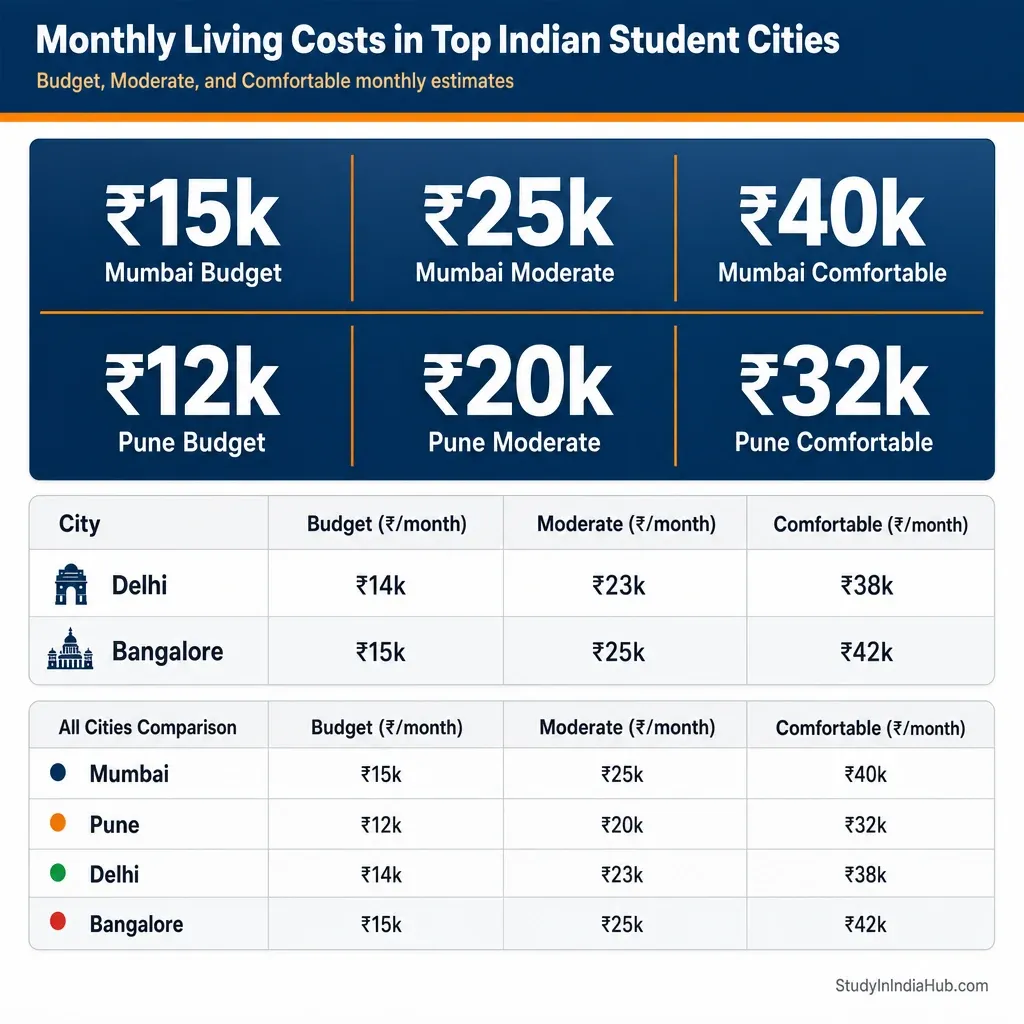
To give these numbers some context, here's what they cover:
- Mumbai: Shared apartment ₹12,000–₹30,000 | Campus hostel ₹5,000–₹15,000 | Food ₹6,000–₹12,000 | Transport ₹500–₹1,500
- Pune: Shared flat ₹8,000–₹20,000 | Food at home ₹4,000–₹8,000 | Dining out regularly ₹8,000–₹12,000
- Delhi: Shared apartment ₹10,000–₹25,000 | Campus hostel ₹5,000–₹12,000
- Bangalore: Budget food options ₹9,000–₹12,000/month | Shared apartment ₹12,000–₹30,000 | Transport ₹1000–₹2000
But here's the catch: A student living comfortably in Pune spends roughly $385/month. A student in Toronto on a tight budget spends about $1,310/month. That's a 4–5x difference in monthly costs just for this.
A four-year Canadian degree costs approximately CA$80,000 in tuition plus CA$57,600 in living costs. Whereas, a four year degree course in India totals roughly $34,000–$40,000. That's a saving of $60,000–$65,000, before scholarships.
What the UK's Fee Page Doesn't Tell You
One additional cost that often surprises students while choosing the UK is the Immigration Health Surcharge (IHS). On top of the £558 student visa fee, international students must pay £776 per year for NHS access. Over a 3-year degree, that's an additional £2,328 which roughly estimates to $3,000 USD.
India's student visa requires proof of INR 10,00,000 (~$12,000 USD) in accessible funds, but does not carry an equivalent recurring healthcare surcharge.
5 Hidden Costs That Wreck Student Budgets
Now that we have discussed about the tuition fees and the living costs, there are certain hidden costs that often disrupt a students budget. These are the expenses that catch students off guard, no matter where they study.
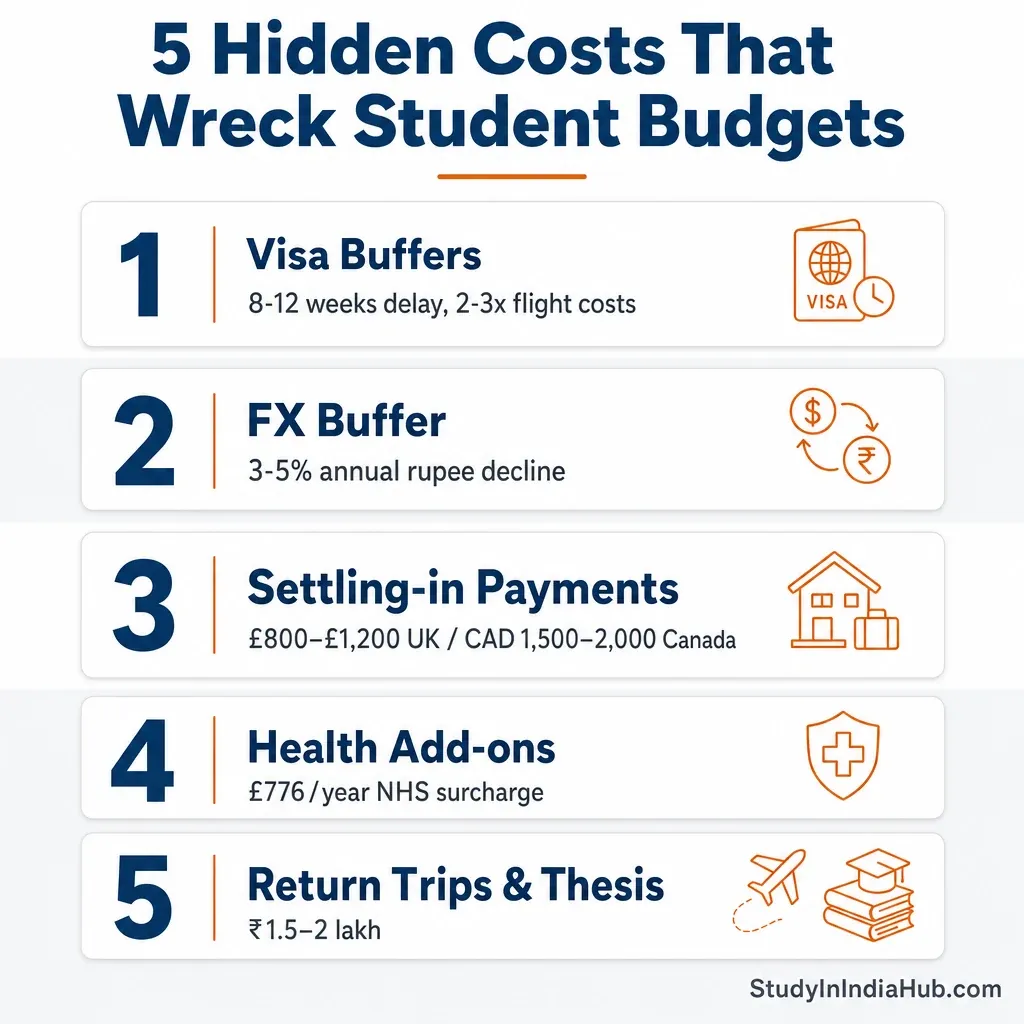
1. Visa Processing Delays: The visa process in UK and Canada can run up to 8–12 weeks. If you book flights before your visa arrives, last-minute fares are typically 2–3 times more expensive.
2. No FX Buffer: Recently the value of rupee has declined 3–5% annually against GBP and CAD. If you lock in a tuition figure today, you may be short by Year 2 due to currency movement alone.
3. The "Settling-In" One-Time Cost: In the UK, first-month costs for a deposit, bedding, winter clothing, a SIM card, and transit passes typically run £800–£1,200. In Canada, budget CAD $1,500–$2,000.
4. Health Add-Ons: The UK's NHS surcharge is £776 per year (UK Gov) as discussed above. Also healthcare gaps across Canadian provinces can add more costs depending on your province of study.
5. Return Trips and Thesis Printing: Two yearly flights home plus dissertation binding can total ₹1.5–2 lakh over the course of a degree.
ROI: Does Cheaper Always Mean Better Value?
When calculating the cost factor, India's advantage is pretty clear. But it comes with one significant trade-off. After graduating, working in India requires an Employment Visa with a sponsoring employer and a minimum salary of USD $25,000 annually. You cannot job-hunt freely the way you can on a UK Graduate Route visa or a Canadian PGWP.
The UK gives graduates a 2-year visa with no sponsorship required. Whereas, Canada offers up to 3 years on an open work permit, with a clear route to permanent residency. Starting salaries in both markets for tech, finance, and engineering typically begin at $50,000–$80,000 USD when compared to $15,000–$25,000 for similar roles in India.
Before jumping to a conclusion, you need to understand that:
Studying in India makes financial sense when you're returning home to South Asia or the Gulf, or targeting a career in the Indian market specifically. A student spending $20,000 in India and landing a sponsored role recovers the full degree cost in under a year.
The UK or Canada justifies the cost when you have a concrete plan to use post-study work rights, have salaries that make the debt repayable within 3–4 years, or you receive a scholarship covering 50% or more of tuition.
Summing Up
The numbers speak for itself. When comparing costs, India is substantially more affordable than the UK or Canada for international students. A 4-year degree in India costs around $19,200 including everything. Whereas, the equivalent in the UK runs over $132,000. This gap is hard to ignore.
If your goal is to build a career in the West, the higher upfront cost of a UK or Canadian education often pays off through post-study work rights, higher starting salaries, and PR pathways. But if you're planning to return home or build a career in South Asia, India's cost advantage is difficult to beat.
Related guides
- How Much Does It Cost to Study in India for International Students? (2026 Breakdown)
- India vs UK for International Students: Cost, Quality & ROI Compared (2026)
- Cheapest Countries to Study Abroad: Global University Fee Comparison (2026)
- India vs Canada vs Australia: Where Should International Students Study? (2026)
- MBA in India for International Students: Best Colleges, Fees & ROI (2026)