Top Universities in Pune for International Students (2026 Guide)
Pune hosts 10,000+ international students and is a popular choice in 2026 among students. With colleges like Symbiosis, SPPU, VIT Pune, Bharati Vidyapeeth and more, here's how you can pick the right one.

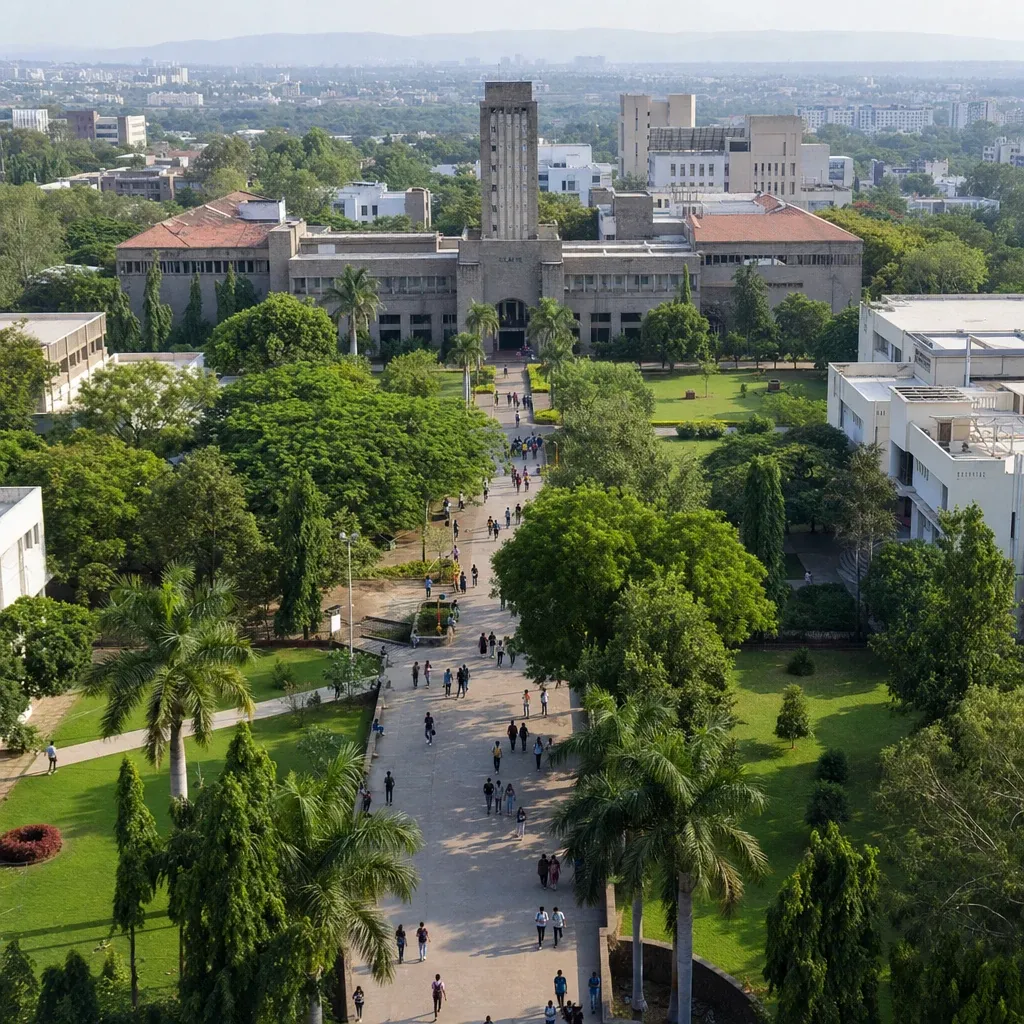
Pune has spent decades earning its reputation as a student city. It is known as the "Oxford of the East" due to three main reasons: it offers stringent educational curriculums, costs are less compared to Mumbai. Additionally, it provides enhanced security for international students. Savitribai Phule Pune University (SPPU) SPPU alone hosts around 10,000 international students from over 100 countries; the largest international cohort at any single university in India.
But "Pune" covers a lot of ground. Along with SPPU, Symbiosis is a private deemed university with a strong reputation in business and law. VIT Pune, MIT-WPU, FLAME, IIIT Pune, Dr. D.Y. Patil, and Bharati Vidyapeeth all sit in the same city and serve very different students.
This guide works through each institution, what it does well, what it costs, and who it's actually built for.
The Top Universities in Pune
Pune has a lot of universities and each has their own specializations, cost range and cultural atmosphere. I've compiled and contrasted the leading institutions in Pune below.
Savitribai Phule Pune University (SPPU)
SPPU is Pune's flagship public university, ranked #37 nationally in NIRF 2024 and holding an A+ NAAC grade. With nearly 500,000 students across its affiliated colleges, it's one of India's largest universities by any measure.
The dedicated International Centre manages admissions, visa support, documentation, and orientation. It's one of the more functional setups for international students at any Indian public university, which matters when you need an admission letter urgently or have a question about FRRO registration that isn't answered anywhere online. Programmes span engineering, humanities, sciences, commerce, law, and professional fields.
Symbiosis International University (SIU)
Founded in 2002 and holding a NAAC A++ grade, Symbiosis is the most internationally recognized private institution in Pune. Its strength is concentrated in business, law, liberal arts, media, and design, and is built specifically to handle international students at scale.
Unlike domestic-quota admissions, SIU permits foreign students to enrol in up to 15% of seats above the sanctioned intake for each programme, which means you're not competing directly with Indian students for limited spots.
For an MBA courses, the standard requirement is a recognized bachelor's degree in any discipline with at least 60% aggregate. Dedicated hostel areas, assigned advisors, and a pre-term orientation for international students are standard. SIU also maintains exchange and dual-degree partnerships with universities in the US, UK, and Australia.
VIT Pune
VIT Pune is an autonomous engineering institution where the placement record speaks more clearly than the marketing. In 2023, the institute reported a 100% placement rate with an average CTC of ₹32,23,000, the highest it had recorded at the time, with 59 offers in IT and Analytics alone.
It's a focused institution: if your goal is engineering or computer science and you want a clear line to corporate placement, VIT Pune is worth a serious look. The campus facilities are strong and engineering-oriented.
MIT-WPU
MIT World Peace University is a private institution offering a broader, more interdisciplinary range than VIT Pune. Its distinctive element is a Peace Studies curriculum woven through its technical and management degrees — which is either a meaningful differentiator or an irrelevance, depending entirely on what you're studying.
There are no verified public rankings or placement data for MIT-WPU. Review the latest brochure and the official admissions site before making any decision, and ask admissions for department-specific placement figures from the last two years.
Dr. D.Y. Patil Vidyapeeth and Bharati Vidyapeeth
These are Pune's main private deemed universities for medicine, dentistry, engineering, law, and management. Both operate with autonomy over their own curriculam and admissions, which gives them more flexibility on deadlines than public institutions, and makes them a practical option.
IIIT Pune and PICT
These two colleges serve a specific kind of student: one who wants computer science or IT without competing for IIT seats, and who prioritizes research or industry connections over brand name.
IIIT Pune has a stronger research emphasis within its IT curriculum. Whereas, PICT has deeper corporate connections and a well-established placement cell within Pune's tech ecosystem. But the catch is neither institution publishes international enrollment data publicly, so contact admissions directly for current intake figures and international student support arrangements.
FLAME University
FLAME is Pune's liberal arts outlier which is modelled on the American liberal arts college format, with broad foundational coursework. It suits students whose background runs toward policy, media, economics, or social sciences rather than engineering or pure sciences. If that's your direction, FLAME is the only institution in Pune doing this format seriously.
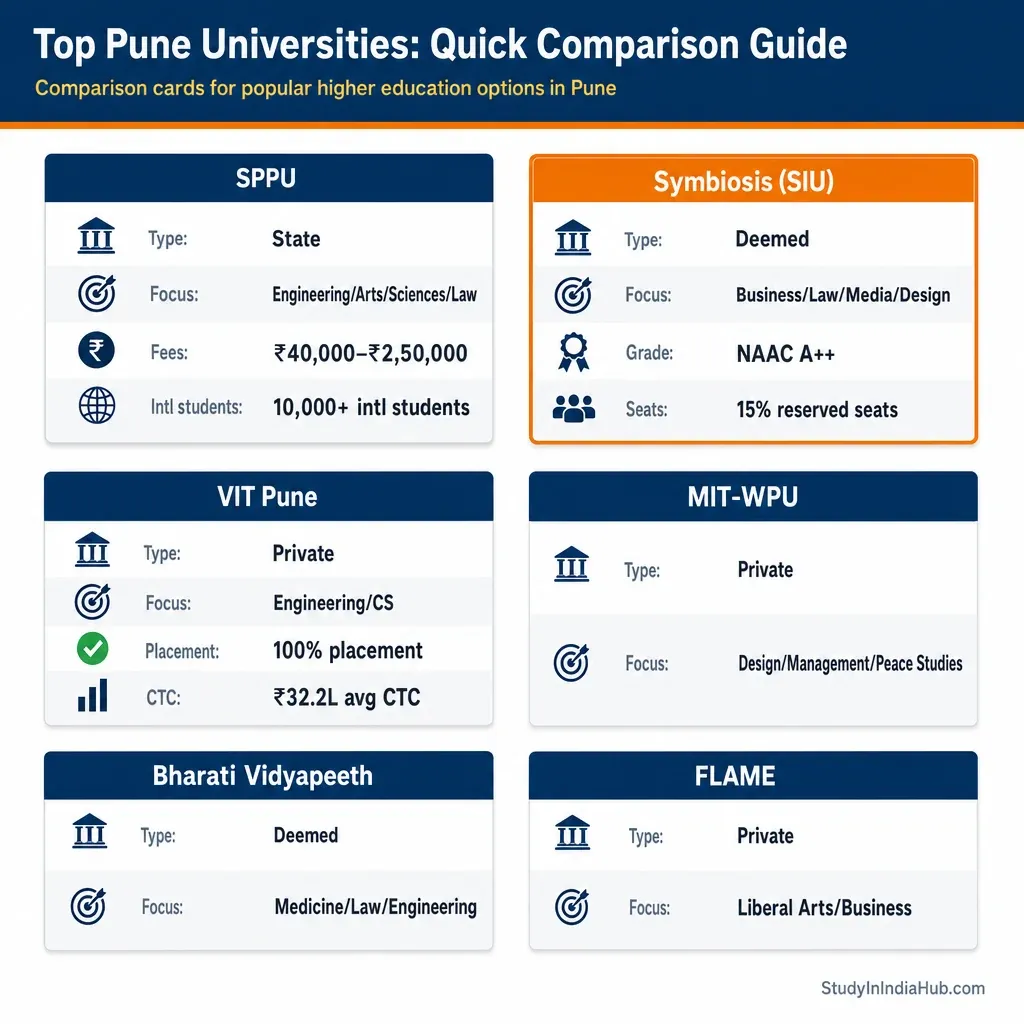
Here's a quick reference across all institutions:
| Institution | Type | Flagship Programs | Approx. Annual Fees (International) | International Support |
|---|---|---|---|---|
| SPPU | State (Autonomous) | Engineering, Arts, Sciences, Law | ₹40,000–₹2,50,000 (hostel + mess included) | Dedicated International Centre; ~10,000 students from 100+ countries |
| Symbiosis (SIU) | Deemed | Business, Law, Media, Liberal Arts | Verify on program page | Centralized international admissions; strong alumni network |
| VIT Pune | Private/Autonomous | Engineering, Computer Science | Verify on program page | On-campus facilities; engineering-focused |
| MIT-WPU | Private | Engineering, Design, Management | Verify on program page | Support varies by school; confirm contacts |
| Bharati Vidyapeeth | Deemed | Medicine, Engineering, Management, Law | Verify on program page | Multiple campuses; wide program range |
| Dr. D. Y. Patil | Deemed | Medicine, Dentistry, Engineering | Verify on program page | Confirm campus-wise desk |
| IIIT Pune | Central (Autonomous) | Computer Science, IT, Electronics | Verify on program page | Tech focus; limited international intake |
| FLAME University | Private | Liberal Arts, Business | Verify on program page | Interdisciplinary approach |
What Studying in Pune Actually Costs
Now that we have covered the major colleges in Pune, the biggest differentiator is cost. The table on a university website is always a starting point, never a total. Your real cost has three components: tuition, hostel and mess, and monthly living. Let's look at it in detail.
Tuition by Programme Type
When compared based on programme, the fees vary significantly between public and private institutions:
| Program Type | Annual Tuition (International) | Comparison Point |
|---|---|---|
| BTech / Engineering | ₹60,000 – ₹7,70,000 | IIT Bombay: ₹3,23,350 (IIT Bombay) |
| MBA / Management | ₹42,600 – ₹8,40,000 | Nirma integrated BBA-MBA: $6,650/yr |
| MBBS | ₹25,000 – ₹5,00,000 | Mumbai University (University Website) |
| DASA Scheme (non-SAARC) | ~$4,000 per semester | Fixed rate, specific technical institutes |
Under the DASA programme, non-SAARC students pay a fixed $4,000 per semester with no additional currency variation which is one of the cleaner pricing structures in the system.
Hostel and Living Costs
On-campus hostel and mess fees typically run ₹1,000–3,000/month, or ₹40,000–2,50,000/year. For off-campus accommodation, a shared apartment in most Pune student areas runs ₹8,000–15,000/month. Daily meals at a campus canteen cost ₹100–300 per meal.
| City | Avg. Annual Cost (Tuition + Living) | Placement Rate | International Support |
|---|---|---|---|
| Pune | $7,000–$12,000 | 80–90% | Dedicated cells, hostel priority |
| Bangalore | $9,000–$15,000 | 85–92% | Strong, tech-industry linked |
| Mumbai | $11,000–$18,000 | 82–90% | Good, but high housing costs |
| Delhi | $8,000–$14,000 | 80–88% | Established, large cohorts |
When compared, Pune consistently undercuts Mumbai on both tuition and living costs without giving up much on placement outcomes. A four-year degree in Pune typically runs ₹15–25 lakh less than an equivalent programme in Mumbai.
Life as an International Student in Pune
As an international student, Pune is a great destination because it has a lot to offer in terms of education, opportunities, culture and exposure. But if we talk about technicalities, there are certain things that you should be informed about.
Work Rights and Internships
Student visa holders in India cannot work off-campus. Internships are allowed, but only with explicit university approval. A paid role without university's consent can create visa complications that are difficult to untangle.
Pune's proximity to major tech companies and manufacturing hubs means internship opportunities exist. The alumni networks at SPPU and Symbiosis tend to generate leads and increase placement awareness, but those connections need to be activated, not assumed.
Banking and Registration
To open a bank account, you'll need self-signed copies of the first and last four pages of your passport, your visa with the immigration stamp, and your official admission letter. Have these ready before you arrive as missing any one of them delays local registration and scholarship disbursements.
FRRO registration is mandatory within 14 days of arrival for any visa valid over 180 days. Do it through the e-FRRO portal (indianfrro.gov.in/eservices). Missing the window results in penalties and complicates future visa renewals.
Choosing Your Location Within Pune
Not all of Pune is equally convenient for students. Areas like Kalyani Nagar and Viman Nagar are well-regarded for safety and student infrastructure. Before accepting a hostel or rental offer, check how long the commute to your specific campus takes as Pune's traffic patterns mean that a seemingly close address can add significant daily travel time.
Three Things That Actually Decide Your Shortlist
With costs and campus life in view, here's the practical framework for narrowing down:
NAAC accreditation - Use it as your baseline filter. SPPU holds A+; SIU holds A++. Many scholarship bodies, including ICCR, only support students at institutions rated A or above. Verify the grade on the official NAAC website, not the university's promotional page.
International student support - A dedicated International Students Cell that handles visa support, FRRO registration, and document processing is meaningfully different from a general admissions email. Contact the cell before you apply and ask a specific question as it will tell you a lot about their response time and how well they can manage.
Programme-specific placement data - University-level placement rates obscure what happens at the department level. Ask for placement statistics for your specific programme, including what percentage of international students were placed and at which companies.
How to Apply and Get Started
Now that you are looking to apply, there are certain steps that you need to follow. The sequence here is non-negotiable as each step unlocks the next, and missing one can push your intake back by a full year.
A typical engineering applicant to an SPPU-affiliated college starts document preparation in October, receives a provisional offer letter by December, uses that letter to apply for the S-1 student visa (which takes approximately 4–6 weeks to process), and arrives in July for orientation. Students who receive their offer letter before March face noticeably fewer complications with visa processing and accommodation than those who apply close to the deadline.
The S-1 student visa is entirely document-based and has no interview. Applications stall primarily because of inconsistencies in financial documents or missing attestations. A verified admission letter, current bank statements, and a clear academic timeline are what move an application forward.
For IELTS: if your score is close to the cutoff, don't wait for results to start your application. IELTS on Computer returns results within 1–5 days, and some universities accept applicants conditionally while results are pending. A score 0.5 bands below the requirement is worth a direct conversation with admissions, some institutions offer foundational English modules and accept 5.5 with an English course in the first semester.
The Bottom Line
Now that you have a clear picture, its safe to say that Pune works well for international students because the infrastructure for them actually exists. SPPU's International Centre, Symbiosis's protected international intake and the city's student-oriented economy makes it a popular choice.
What it requires is choosing the right institution for what you're actually studying. Why? Because the distinction between these institutions matters more than the city's overall reputation.
Related guides
- Best Universities in India for International Students (2026 Rankings + Fees)
- Top 10 Private Universities in Mumbai for International Students (2026)
- Is India a Good Place to Study for International Students? (Honest Review 2026)
- Top Universities in Mumbai for International Students (2026 Guide)
- MBA in India for International Students: Best Colleges, Fees & ROI (2026)
- IIT vs SPPU: Which Is Better for Nepali Students to Study Engineering?
- IIT vs SPPU: The Right University for Nepali Students
- NIT vs SPPU: Which Is Better for Nepali Students to Study Engineering?
- NIT vs SPPU: The Right University for Nepali Students